
Madikwe Game Reserve
An 80,000-hectare malaria-free Big Five reserve on the Botswana border, restored from depleted farmland by Operation Phoenix, one of history's largest wildlife translocations. Reliable wild dog packs, 900+ elephants, exclusive lodge-only access, and a 3-vehicle-per-sighting rule.
Malaria-Free Big Five on the Botswana Border
Photo by Kelley Jean Main on Unsplash
About Madikwe Game Reserve
By the early 1990s, the land that would become Madikwe Game Reserve was overfarmed, degraded, and ecologically exhausted. The decision to restore it to wildlife habitat rather than continue attempting agriculture was not merely conservation, it was economics. The calculation showed that a functioning game reserve would generate more revenue per hectare than the land could ever produce as marginal farmland. Operation Phoenix, one of the largest wildlife translocation projects in history, introduced over 8,000 animals to the newly fenced 80,000-hectare reserve. Elephants, lions, rhinos, buffalo, and leopards came first; wild dog packs followed; cheetah, hyena, and hundreds of other species gradually established territories in a landscape that relearned how to be wild over the subsequent decades.
Madikwe operates on a strictly exclusive model. No day visitors. No self-drive. All game drives conducted by lodge-assigned guides and trackers in private vehicles. Maximum three vehicles at any sighting, the rule that keeps the experience intimate rather than commercial. The Kalahari sand landscape gives the reserve a distinct visual identity, drier and more open than the Lowveld, with red sand visible beneath the mopane and acacia woodland. This open character makes game viewing different: animals are visible across greater distances; predators hunting on the open plains are observable in a way dense forest habitat prevents.
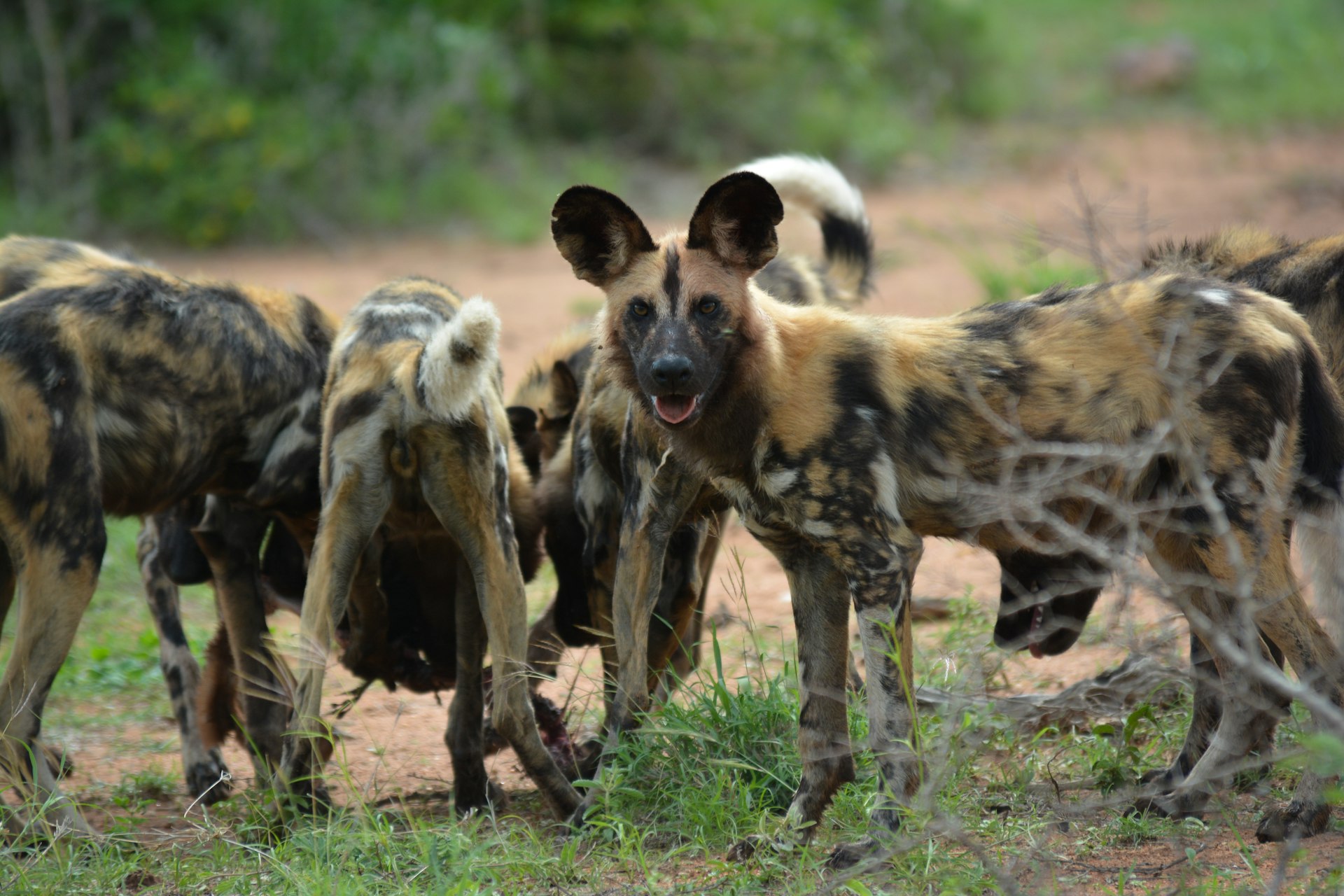
The wild dog packs are Madikwe's most distinctive credential. These endangered, highly mobile predators need vast territories to function, Madikwe's 80,000 hectares provide the space, and pack sightings here are among the most reliable in South Africa. The highly social behaviour of wild dogs, the greeting ceremony, the communal hunt, the pup rearing at the den, make extended sightings of 30–60 minutes among the most compelling wildlife experiences available. Beyond the dogs, the 900+ elephant herd is one of the largest concentrations in any South African reserve; cheetah do well on the open Kalahari terrain; and the desert specialists (brown hyena, pangolin, aardwolf, caracal, bat-eared fox) make Madikwe a significant destination for travellers seeking species rare elsewhere. Crucially, the entire reserve is malaria-free, a major practical advantage for families, pregnant travellers, and those sensitive to antimalarial medications.
Things to Do in Madikwe Game Reserve
Track wild dogs at the den
Madikwe's signature experience. Multiple resident packs with established territories; pup-rearing season (July–September) produces extraordinary sightings as adults return to the den after hunts and the pups rush out for greeting ceremonies. The pack's social complexity, communal hunting, regurgitation feeding, the strict hierarchy, makes 30–60 minute sightings unforgettable.
Game drive the open Kalahari sand
The drier, more open terrain compared to the Lowveld delivers exceptional sightlines. Predators hunting on the plains are observable across distance; elephant herds of 50+ are reliable along the riverine corridors; cheetah find ideal hunting country on the open ground. Lodge-assigned guides manage the strict 3-vehicle-per-sighting rule.
Photograph from a waterhole hide
Several Madikwe lodges position photography hides at productive waterholes, daytime independent wildlife photography during the rest hours between morning and afternoon drives. A valuable complement to the standard game drive programme, particularly for serious photographers who want close, low-angle perspectives.
Look for the desert specialists
Brown hyena (nocturnal, remarkable on spotlight drives), pangolin (rare; confirmed sightings make Madikwe a significant pangolin destination), aardwolf, caracal, bat-eared fox. The Kalahari fringe supports species that are difficult to see in the Lowveld, and dedicated trackers know where to look.
Walking safari with armed rangers
Several lodges offer guided walking safaris in the cooler early morning. The Kalahari sand terrain is suited to walking, open enough for safety, varied enough to be interesting. A different register from the vehicle drives, focused on tracking, plants, and the fine detail of the bush.
Combine with Pilanesberg
Madikwe and Pilanesberg are both in the North West Province; a combined itinerary covering both reserves (4 nights Madikwe + 2 nights Pilanesberg) is logistically coherent. The two reserves are ecologically distinct, Madikwe's Kalahari sand vs Pilanesberg's volcanic crater, and complement each other well for travellers wanting variety in a single trip.
When to Visit Madikwe Game Reserve
Peak Dry
May, October
The classic safari window. Vegetation thins, water sources concentrate wildlife, and the open Kalahari terrain delivers exceptional sightlines for predator viewing. July–September is the wild dog denning season, extraordinary opportunities to observe pup-rearing at established dens. October is the hottest and the most intense for game viewing; June through August is the most comfortable for daytime drives.
Shoulder
April / November
Transition months with mostly settled weather, fewer visitors, and good wildlife access. April is post-rains with green landscape and improving sightings; November is pre-rains with the bushveld at its driest before the storms arrive. Excellent value windows.
Green Season
December, March
Summer rains turn the Kalahari sand vivid green. Wildlife disperses across the wider reserve as water becomes available throughout. Birding is exceptional with migrants arriving in force. Calving season produces predator activity. Lower lodge rates and dramatic skies; afternoon thunderstorms are common.
Getting to Madikwe Game Reserve
From Johannesburg's OR Tambo (JNB) is approximately 5 hours by road via the N4 to the North West province. Most luxury guests opt for the 1-hour light charter flight directly to one of the lodge airstrips inside the reserve, included in the rates at most premium properties. Self-drive is possible but the entry-permit process and the strict no-private-vehicle rule inside the reserve mean most road travellers leave their cars at the gate and transfer to lodge vehicles. From Botswana, the Tlokweng Gate near Gaborone provides the closest approach for travellers combining Madikwe with Botswana itineraries.
Where to Stay
Madikwe specialises in ultra-luxury and family-friendly lodges. Royal Malewane is among the most awarded safari lodges in Africa, palatial suites, private chefs, 4:1 staff-to-guest ratio, and the Africa Foundation conservation programme. Jaci's Safari Lodge and Jaci's Tree Lodge are family-friendly, with excellent children's programming and treehouse-style accommodation. Madikwe Hills Private Game Lodge has an elevated position with panoramic views and dedicated photography hides at productive waterholes. Most lodges include light charter flights from Johannesburg. Three to four nights is the right length to access the full activity range without rushing the wildlife.
Travel Tips for Madikwe Game Reserve
Frequently Asked Questions
- How does Madikwe compare to the Sabi Sands?
- Different reserves with different strengths. Sabi Sands is famous for leopard density and Big Five habituation; Madikwe is known for wild dogs, malaria-free access, and exclusive 3-vehicle limits. Madikwe is generally cheaper than the Sabi Sands' top properties, malaria-free (Sabi Sands is not), and weights more toward open-plain wildlife than dense bushveld viewing.
- Are the wild dogs really that reliable?
- Yes, Madikwe is one of the most consistent wild dog destinations in South Africa. Multiple packs with established territories; experienced trackers know each pack's general range; den sightings during pup season are extraordinary. Sightings are not guaranteed (these are wild animals), but most multi-night visits encounter wild dogs at least once.
- Can children visit?
- Yes, and Madikwe's malaria-free status makes it one of the best South African Big Five destinations for families with young children. Several lodges (Jaci's Tree Lodge, Madikwe Hills) run family-focused programming including dedicated children's activities and ranger-tracker engagement. Confirm minimum-age policies for game drives at booking.
- How many days do I need at Madikwe?
- Three nights minimum, four ideal. Less than three risks missing wild dog sightings or being weathered out of a key activity. Five nights gives you the full activity range plus rest days; combining with Pilanesberg or Sun City extends a single trip to 6–7 nights without diminishing returns.
Explore More, Madikwe Game Reserve
Things To Do
Plan Your Trip
More in South Africa
Kruger National Park
Nearly two million hectares of savanna, riverine forest, and granite kopjes, and one of the most accessible places on Earth to see the Big F…
Cape Town
Wedged between Table Mountain and two oceans, Cape Town is one of the most beautifully sited cities on Earth, and one of the most rewarding …
The Garden Route
A 300-kilometre coastal drive between Mossel Bay and Storms River, threading through ancient forests, lagoons, surfing beaches, and dramatic…
Cape Winelands
Three hundred years of winemaking, set against jagged mountains and Cape Dutch farmsteads an hour from Cape Town. Stellenbosch, Franschhoek,…
Eastern Cape Reserves
South Africa's malaria-free safari circuit anchored on Addo Elephant National Park and the surrounding private reserves (Shamwari, Kwandwe, …
KwaZulu-Natal & the Drakensberg
South Africa's most geographically diverse province, Hluhluwe-iMfolozi (the world's oldest reserve, where the southern white rhino was saved…
Johannesburg
South Africa's economic engine and the most underestimated city on a typical southern Africa itinerary. The Apartheid Museum, Soweto's Vilak…
Sun City & Pilanesberg
Three hours from Johannesburg, Sun City, Africa's most elaborate purpose-built entertainment resort, sits beside Pilanesberg National Park, …
Panorama Route & Mpumalanga
The dramatic escarpment drive north of Kruger, the third-largest canyon on earth (Blyde River, the world's largest green canyon), Bourke's L…