
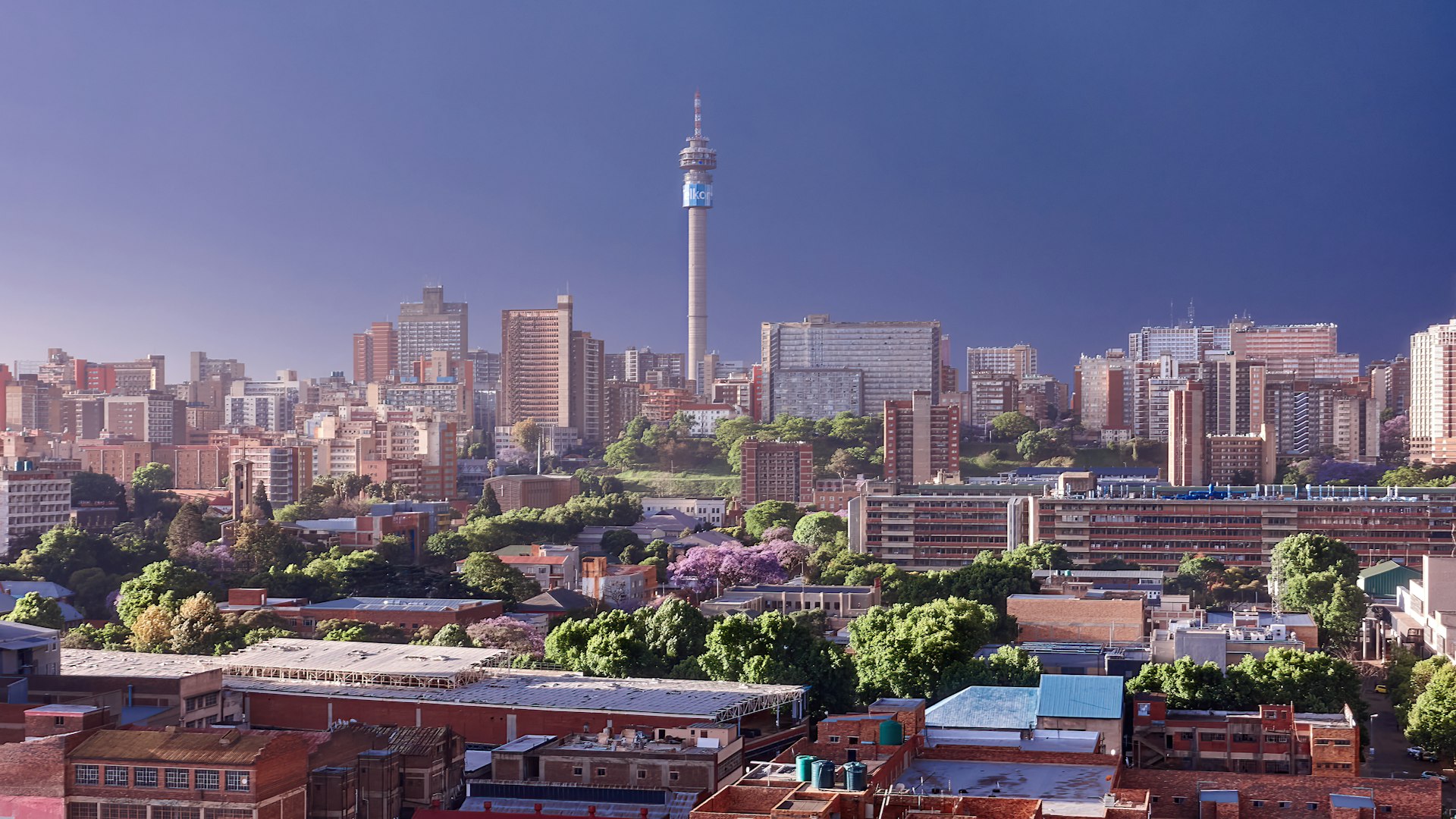
Johannesburg
South Africa's economic engine and the most underestimated city on a typical southern Africa itinerary. The Apartheid Museum, Soweto's Vilakazi Street, Constitution Hill, and the arts districts at Maboneng make Johannesburg the country's deepest urban historical experience.
The City of Gold
Photo by Simon Hurry on Unsplash
About Johannesburg
The standard approach to Johannesburg is to spend one night there, find it intimidating and confusing, and leave for Kruger the next morning. This is understandable and also a significant mistake. Johannesburg, Jozi, the City of Gold, eGoli, is the economic engine of the African continent, and beneath the security fences, the gated compounds, and the highway infrastructure, there is a city of profound cultural and historical weight. The Apartheid Museum is one of the world's great museums of any kind. Constitution Hill, where the Constitutional Court was built in 2004 on the site of Johannesburg's most notorious prison, is an extraordinary architectural and political statement. The Mandela House in Soweto is the most humanizing of all the Mandela heritage sites. And the city's arts districts, Maboneng, Newtown, 44 Stanley Avenue in Auckland Park, pulse with an energy that the sanitized luxury of Sandton does not represent.
Give Johannesburg two nights. Go to Soweto. Visit the museum. Come back changed. The Apartheid Museum is the most important museum in South Africa and one of the most significant in the world, comprehensive, immersive, and emotionally demanding. The entry process is carefully designed: visitors are randomly assigned a "white" or "non-white" entry pass and proceed through different gates, a small immediate experience of the system's logic. Allow 3–4 hours minimum; the exhibition is extensive and the emotional weight is real. Constitution Hill on the site of the Old Fort Prison preserves the brutal interior of the Number Four Prison and the Women's Gaol, while the Constitutional Court built within the former prison walls represents the most significant architectural statement of post-apartheid South Africa. The Flame of Democracy burns continuously on the building's forecourt.
Soweto is the city within the city. Mandela House on Vilakazi Street, where Nelson Mandela lived from his marriage in 1958 until his arrest in 1962, has been preserved as it was: modest, personal, and more humanizing than any photograph of Mandela can be. A few houses down, Archbishop Desmond Tutu also lived on Vilakazi Street, the only street in the world to have been home to two Nobel Peace Prize laureates. Walter Sisulu Square (where the Freedom Charter was signed in 1955) and the Hector Pieterson Museum (commemorating the 1976 student uprising) round out Soweto's mandatory historical circuit. Beyond the heritage sites, Johannesburg's contemporary energy lives in the Maboneng Precinct (the regenerated arts district with galleries, restaurants, and street art), 44 Stanley Avenue (the converted-warehouse lifestyle hub in Auckland Park), and the city's reputation as the world's largest urban forest, 10 million trees planted across the northern suburbs, an unexpected green canopy that the highway infrastructure does not reveal.
Things to Do in Johannesburg
Spend half a day at the Apartheid Museum
The most important museum in South Africa and one of the most significant globally. Comprehensive, immersive, and emotionally demanding. The entry process, random white/non-white pass assignment, is part of the experience. Allow 3–4 hours minimum; rushing diminishes the experience.
Tour Soweto with a township-based guide
Mandela House on Vilakazi Street, the Hector Pieterson Museum, Walter Sisulu Square (where the Freedom Charter was signed). Township-based operators ensure tourism revenue benefits the community directly and provide context that outside operators cannot. Morning tours (08:30 start) avoid midday heat and cover the circuit comfortably in 4 hours.
Visit Constitution Hill
The Constitutional Court of South Africa built into the walls of the Old Fort Prison, the building incorporates original prison brick and steel into post-apartheid architecture in a deliberate symbolic gesture. The Flame of Democracy, the Number Four Prison and Women's Gaol exhibits, and the architectural significance of the court itself make this an essential stop for any history-interested visitor.
Walk the Maboneng arts district
The regenerated section of the inner city east, galleries, restaurants, studios, and street art representing contemporary urban South African creative energy. The Arts on Main market on Sundays is the most vibrant moment; the Falko mural is one of the city's largest street art pieces. A different register from the Sandton corporate hub.
Eat at 44 Stanley Avenue
The Auckland Park lifestyle precinct, converted warehouses housing independent restaurants, design stores, and cafés. Salvation Café, Zietsies Dining-Room, and Il Giardino are consistently good. A useful evening anchor away from the corporate atmosphere of the northern suburbs.
Catch the jacaranda bloom
From late October through November, Johannesburg's northern suburb avenues explode into purple jacaranda bloom. Houghton, Killarney, and the streets around the Westcliff Ridge are the most famous viewing zones. A specifically Joburg phenomenon, and a reminder that the world's largest urban forest produces unexpected botanical drama.
When to Visit Johannesburg
Highveld Winter
May, August
Cool, dry, sunny days and cold nights at 1,753m elevation. The most pleasant urban weather, clear skies, low humidity, and the comfortable temperatures that make walking the Apartheid Museum and Constitution Hill enjoyable. Pack warm layers, Joburg evenings can drop to freezing in mid-winter.
Spring & Autumn
September, November / March, April
Warming or cooling temperatures with mostly settled weather. Spring brings the famous Johannesburg jacarandas, the city explodes into purple bloom from late October, one of the most distinctive urban displays in southern Africa. An optimal window for first-time visitors.
Highveld Summer
December, February
Warm days with dramatic afternoon thunderstorms. Lightning strikes the Highveld with extraordinary intensity; the storms are fast and powerful but rarely last long. Lush gardens and the urban forest at its greenest. Lower visitor numbers compared to the safari peak season; modest accommodation reductions.
Getting to Johannesburg
O.R. Tambo International Airport (JNB) is Africa's busiest hub, with direct flights from major global cities and the most extensive regional connectivity on the continent. The Gautrain rapid-transit railway connects the airport to Sandton (15 minutes), Rosebank, Park Station, and Pretoria, clean, punctual, and the most reliable airport-to-city connection. From Cape Town and Durban, internal flights are 2 hours; from Kruger gateway towns (Nelspruit, Hoedspruit), about 1 hour by air or 5 hours by road.
Where to Stay
Four Seasons Hotel The Westcliff is tiered into the Westcliff Ridge with exceptional city views, the most prestigious traditional luxury address. Fairlawns Boutique Hotel & Spa in Sandton is idiosyncratic and highly personalised. Radisson Blu Gautrain Hotel sits directly on the Gautrain line, the most practical choice for business travellers. In the mid-range, Indaba Hotel, @Sandton Hotel, and Hampton By Hilton Sandton Grayston are reliable. Hotel Sky is a newer Sandton property with ambitious design. The Pecan Tree is the recommended budget option in the northern suburbs. Two nights minimum to engage with the city; three nights for thorough cultural exploration.
Travel Tips for Johannesburg
Frequently Asked Questions
- Is Johannesburg actually safe for tourists?
- Yes, with informed precautions. The northern suburbs (Sandton, Rosebank, Auckland Park, Westcliff) are safe for daytime activity. The inner city and Soweto are safe with a guide during the day; both are unsafe for unaccompanied tourists at night. Secure parking, hotel-to-hotel Uber for evenings, and avoiding visible wealth on streets covers most safety concerns. Most travellers complete Johannesburg visits without incident.
- Is the Apartheid Museum genuinely worth 3–4 hours?
- Absolutely. The exhibition is dense, comprehensive, and emotionally demanding. Visitors who try to see it in 90 minutes leave with a partial experience. The full visit, taking time with each section, sitting with the difficult material, is what produces the deep impact this museum is famous for. Plan it for the morning when energy is fresh.
- How does Johannesburg compare to Cape Town?
- Different cities, both essential. Cape Town is scenic, leisure-focused, and visually stunning. Johannesburg is gritty, historically dense, and economically central. Cape Town shows you South Africa's beauty; Johannesburg shows you its history and contradictions. Most international visitors do Cape Town for 4–5 days and Joburg for 2–3, both deserve more.
- Should I extend to Pretoria as well?
- If you have time, yes. Pretoria is 30–40 minutes north of Sandton via the Gautrain, the Voortrekker Monument, the Union Buildings (where Mandela was inaugurated as President in 1994), and the Pretoria CBD's colonial architecture form a coherent half-day excursion. The two cities make sense as a Gauteng pairing rather than alternative destinations.
Explore More, Johannesburg
Things To Do
Plan Your Trip
More in South Africa
Kruger National Park
Nearly two million hectares of savanna, riverine forest, and granite kopjes, and one of the most accessible places on Earth to see the Big F…
Cape Town
Wedged between Table Mountain and two oceans, Cape Town is one of the most beautifully sited cities on Earth, and one of the most rewarding …
The Garden Route
A 300-kilometre coastal drive between Mossel Bay and Storms River, threading through ancient forests, lagoons, surfing beaches, and dramatic…
Cape Winelands
Three hundred years of winemaking, set against jagged mountains and Cape Dutch farmsteads an hour from Cape Town. Stellenbosch, Franschhoek,…
Madikwe Game Reserve
An 80,000-hectare malaria-free Big Five reserve on the Botswana border, restored from depleted farmland by Operation Phoenix, one of history…
Eastern Cape Reserves
South Africa's malaria-free safari circuit anchored on Addo Elephant National Park and the surrounding private reserves (Shamwari, Kwandwe, …
KwaZulu-Natal & the Drakensberg
South Africa's most geographically diverse province, Hluhluwe-iMfolozi (the world's oldest reserve, where the southern white rhino was saved…
Sun City & Pilanesberg
Three hours from Johannesburg, Sun City, Africa's most elaborate purpose-built entertainment resort, sits beside Pilanesberg National Park, …
Panorama Route & Mpumalanga
The dramatic escarpment drive north of Kruger, the third-largest canyon on earth (Blyde River, the world's largest green canyon), Bourke's L…