
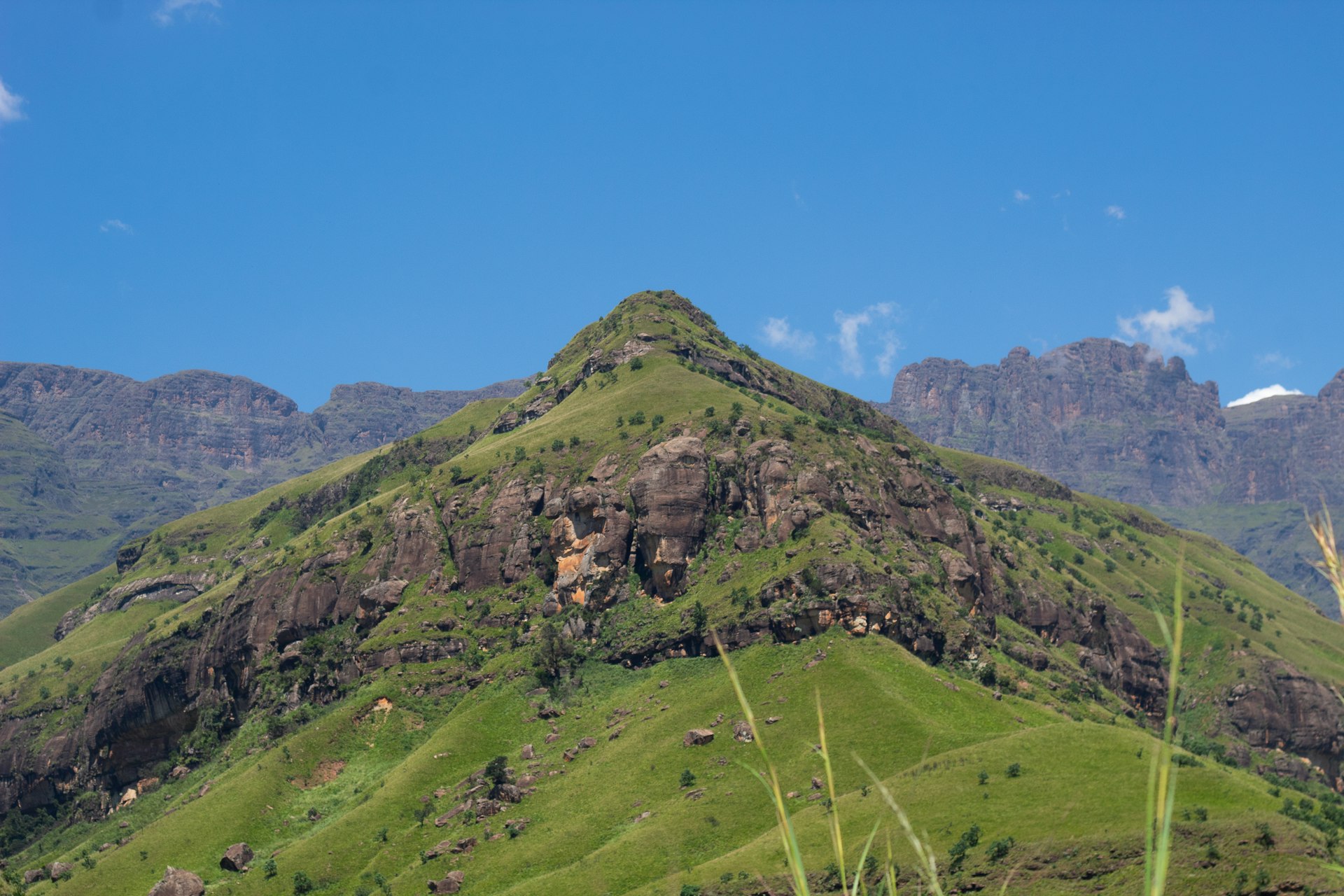
KwaZulu-Natal & the Drakensberg
South Africa's most geographically diverse province, Hluhluwe-iMfolozi (the world's oldest reserve, where the southern white rhino was saved from extinction), the iSimangaliso UNESCO coast and Sodwana Bay diving, Phinda's seven ecosystems, the Drakensberg's UNESCO escarpment, and the Zulu battlefields.
Bush, Beach, and the Mountain Kingdom
Photo by Ethan Strydom on Unsplash
About KwaZulu-Natal & the Drakensberg
KwaZulu-Natal is South Africa's most geographically diverse province, a combination that no other province replicates. The northern coast delivers sub-tropical golden beaches on the warm Indian Ocean. The iSimangaliso Wetland Park provides UNESCO-listed ecosystems ranging from coral reefs to turtle beaches. Inland, Hluhluwe-iMfolozi is the oldest reserve in Africa, globally credited with saving the southern white rhinoceros from extinction. Further inland, the Drakensberg rises to a 243,000-hectare UNESCO World Heritage escarpment decorated with San rock art and towering basalt cliffs. The "bush and beach" modality, a few nights of safari followed by a few days on the Zulu Coast, is the quintessential KwaZulu-Natal holiday format, and the province's geography makes it entirely practical in a single itinerary.
Hluhluwe-iMfolozi is the oldest formally proclaimed reserve in Africa (1895), and the site of one of conservation's greatest triumphs: the recovery of the southern white rhinoceros from a population of fewer than 50 individuals in the early 20th century to over 20,000 today. Every southern white rhino alive owes its existence to the work done in this reserve. The park supports all Big Five in varied terrain, the rolling hills of Hluhluwe in the north and the more open, drier iMfolozi in the south create two distinct ecological experiences within a single reserve. Phinda Private Game Reserve covers 23,000 hectares across seven distinct ecosystems (sand forest, mountain, wetland, riverine forest, open woodland, grassland, vlei), with cheetah tracking, black rhino conservation, and the rare sand-forest habitat as differentiators. iSimangaliso encompasses 332,000 hectares of coastal ecosystem, with Sodwana Bay consistently ranked South Africa's premier scuba destination, seven distinct reefs, manta rays, and seasonal whale sharks.
The Drakensberg, "Dragon's Mountain", forms the eastern escarpment of the South African plateau. Its KwaZulu-Natal section is protected as the uKhahlamba-Drakensberg Park (UNESCO World Heritage Site). The Royal Natal National Park's Amphitheatre is a curved 5km basalt wall rising 1,200 metres from the valley floor; from its escarpment edge, the Tugela Falls drop 948 metres in five distinct cascades, making them the second-highest waterfall in the world. Access to the top requires chain-ladder climbing, sections of near-vertical ascent that demand fitness and a reasonable head for heights. The Drakensberg's overhangs contain over 40,000 documented San rock paintings, the largest concentration in the world. Add the 1879 Anglo-Zulu War battlefields at Rorke's Drift and Isandlwana, the Durban food scene anchored by the bunny chow, and KwaZulu-Natal's depth becomes apparent: this is the province where you can have an authentic safari, an Indian Ocean beach holiday, a UNESCO mountain trek, and a colonial history excursion in a single trip.
Things to Do in KwaZulu-Natal & the Drakensberg
Track white rhino at Hluhluwe-iMfolozi
The world's oldest reserve and the site of the southern white rhino's recovery. Self-drive game viewing, guided wilderness trails on foot with experienced rangers, and the rolling Hluhluwe and open iMfolozi sections offer two distinct ecological experiences. The conservation history makes every rhino sighting weighted with significance.
Stay at Phinda Private Game Reserve
Seven distinct ecosystems across 23,000 hectares, sand forest, mountain, wetland, riverine, open woodland, grassland, and vlei. &Beyond's Mountain Lodge and Rock Lodge are architecturally distinctive; the cheetah tracking programme is among the most developed in South Africa; the rare sand-forest habitat is exceptional. Three to four nights covers the diversity.
Dive Sodwana Bay
South Africa's premier scuba diving, seven distinct reef systems with extraordinary coral diversity, manta rays, whale sharks (seasonal), and a fish list that rivals Indian Ocean coastal sites continent-wide. Accessible from established dive operators on the iSimangaliso coast. Best visibility May–September.
Climb the Tugela Falls chain ladders
The Royal Natal National Park's Amphitheatre rises 1,200 metres from the valley floor; from its escarpment edge, Tugela Falls drops 948 metres in five cascades, the world's second-highest waterfall. Access to the top requires the famous chain ladders bolted into the rock face. The 8–10 hour round trip is demanding; start at dawn to avoid afternoon lightning (November–April).
Tour the San rock art
The Drakensberg holds the largest concentration of San Bushman rock art in the world, over 40,000 individual paintings across hundreds of sites. Guided rock art walks from camps in the Cathedral Peak and Giant's Castle areas access specific well-preserved panels with expert interpretation of the eland, hunting scenes, and shamanic figures.
Visit the Anglo-Zulu battlefields
Rorke's Drift and Isandlwana (both 1879) are among the most historically significant heritage sites in South Africa. Expert battlefield guides, whose knowledge of the tactical detail, the human stories, and the military history transforms what could be empty fields into extraordinary encounters with one specific and fateful afternoon. Accessible from several Midlands lodges.
Eat a Durban bunny chow
Do not leave Durban without one. Gounden's in the city is widely regarded as the original and definitive version. A hollow loaf of bread filled with slow-cooked curry, exactly as it sounds and significantly better than you expect. The dish anchors Durban's specific Indian-South African food culture.
When to Visit KwaZulu-Natal & the Drakensberg
Cool Dry
May, September
The most reliable window for both safari (Hluhluwe, Phinda) and the Drakensberg. Cool temperatures, low rainfall, and clear visibility, ideal for game drives, hiking, and the chain-ladder ascent of the Tugela Falls. The Drakensberg can carry snow in mid-winter (June–July). Pack warm layers for highland evenings even in milder months.
Whale Season
June, November
Southern right whales visit the KwaZulu-Natal coast during this window. The marine wildlife dimension extends the province's offering. Sodwana Bay diving operates year-round with the best visibility from May to September.
Summer
October, April
Sub-tropical coast becomes warm and humid; the Drakensberg highlands generate dramatic afternoon thunderstorms with serious lightning risk. Hiking the Tugela Falls in summer requires dawn starts and afternoon descents. Loggerhead and leatherback turtle nesting at iSimangaliso runs November–February. Lower visitor numbers and lower lodge rates.
Getting to KwaZulu-Natal & the Drakensberg
King Shaka International Airport (DUR) north of Durban is the main entry point, direct flights from Johannesburg and Cape Town, plus regional connections. The northern game reserves (Hluhluwe, iSimangaliso, Phinda) are 2–3 hours by road from Durban. The Drakensberg is 3–4 hours west of Durban via the N3 to Pietermaritzburg, then west on regional roads. Self-drive within the province is straightforward; the road network is well-maintained on the main arteries. From Johannesburg, the Drakensberg is 4 hours by road via Harrismith.
Where to Stay
KwaZulu-Natal's accommodation splits across its diverse landscapes. In the northern reserves, Phinda's lodges (operated by &Beyond) are the premier choice. Hluhluwe-iMfolozi has both public-park rest camps and a small number of private concessions. iSimangaliso supports a range of beach lodges and the diving operators at Sodwana Bay. In the Drakensberg, Cathedral Peak Hotel and Champagne Castle Hotel anchor the central peaks; Royal Natal Hotel covers the Amphitheatre area. Durban's Oyster Box on the Umhlanga coast is the most celebrated city-edge hotel. Combining the province's offerings across 7–10 nights is the natural format, 3 nights safari, 2 nights coast, 2–3 nights Drakensberg.
Travel Tips for KwaZulu-Natal & the Drakensberg
Frequently Asked Questions
- How does KZN compare to the Eastern Cape for safari?
- Both provide malaria-free alternatives in part of the province (Drakensberg, Durban) but the northern KZN reserves are malarial. KZN has the world's oldest reserve and Phinda's seven ecosystems; Eastern Cape has Addo's 600+ elephants and the Big 7 marine extension. KZN is the broader province for combining safari with beach and mountain; Eastern Cape pairs more naturally with the Garden Route. Choose based on broader trip structure.
- Is the Tugela Falls hike achievable for moderate hikers?
- It is technically demanding due to the chain ladders, sections of near-vertical climbing requiring confidence with heights and reasonable upper-body fitness. Moderately fit hikers without serious vertigo can do it; nervous climbers should consider the alternative Mount Aux Sources approaches without ladders. The 8–10 hour total is significant, start before dawn and carry serious water.
- How does the Drakensberg compare to other African mountain ranges?
- Larger and more developed than Lesotho's Maluti or the South African Cederberg; less famous than Kilimanjaro or the Atlas. The KwaZulu-Natal Drakensberg is unique for its San rock art density, the Amphitheatre's basalt scale, and the practical hiking infrastructure (mountain huts, marked trails, established guides). For experienced trekkers, it competes with the Drakensberg's Lesotho side and the South African Cederberg as the country's premier hiking destinations.
- Should I focus on the bush, the beach, or the mountains?
- On a 7–10 day trip, all three are achievable. The classic format is 2–3 nights in Hluhluwe or Phinda, 2 nights on the iSimangaliso coast or Sodwana Bay, and 2–3 nights in the Drakensberg. Less time forces a choice, most travellers prioritise either the bush-and-beach combination (skipping the Drakensberg) or the bush-and-mountains combination (skipping the coast). All three is the most rewarding.
Explore More, KwaZulu-Natal & the Drakensberg
Plan Your Trip
More in South Africa
Kruger National Park
Nearly two million hectares of savanna, riverine forest, and granite kopjes, and one of the most accessible places on Earth to see the Big F…
Cape Town
Wedged between Table Mountain and two oceans, Cape Town is one of the most beautifully sited cities on Earth, and one of the most rewarding …
The Garden Route
A 300-kilometre coastal drive between Mossel Bay and Storms River, threading through ancient forests, lagoons, surfing beaches, and dramatic…
Cape Winelands
Three hundred years of winemaking, set against jagged mountains and Cape Dutch farmsteads an hour from Cape Town. Stellenbosch, Franschhoek,…
Madikwe Game Reserve
An 80,000-hectare malaria-free Big Five reserve on the Botswana border, restored from depleted farmland by Operation Phoenix, one of history…
Eastern Cape Reserves
South Africa's malaria-free safari circuit anchored on Addo Elephant National Park and the surrounding private reserves (Shamwari, Kwandwe, …
Johannesburg
South Africa's economic engine and the most underestimated city on a typical southern Africa itinerary. The Apartheid Museum, Soweto's Vilak…
Sun City & Pilanesberg
Three hours from Johannesburg, Sun City, Africa's most elaborate purpose-built entertainment resort, sits beside Pilanesberg National Park, …
Panorama Route & Mpumalanga
The dramatic escarpment drive north of Kruger, the third-largest canyon on earth (Blyde River, the world's largest green canyon), Bourke's L…