
Liuwa Plains National Park
Africa's second-largest wildebeest migration, on a vast minimalist floodplain in remote western Zambia. Dominant spotted hyena clans, intact predator communities, and a wilderness that almost no one knows exists.
Africa's Forgotten Wildebeest Migration
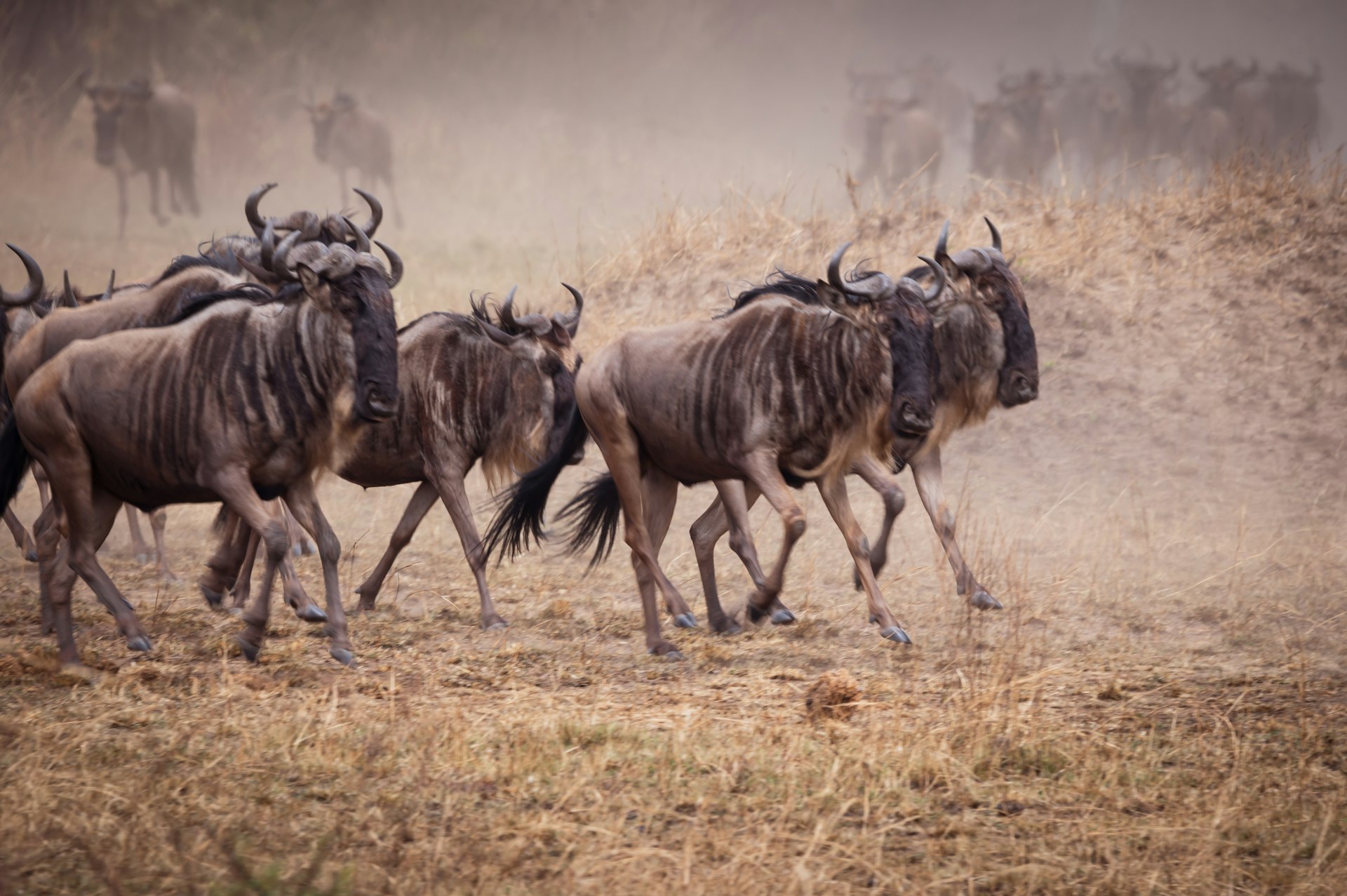
Photo by Helena Pfisterer on Unsplash
About Liuwa Plains National Park
In East Africa, the wildebeest migration draws hundreds of thousands of visitors annually. In Zambia's Western Province, Africa's second-largest wildebeest migration unfolds across a vast, minimalist floodplain that most of those visitors have never heard of. Liuwa Plains National Park sits near the Angolan border, far from the standard safari circuits, accessible only by 4WD or light charter, and that remoteness is both its principal challenge and its defining virtue.
Between October and December, tens of thousands of blue wildebeest converge on the plains in their annual movement, shadowed closely by the park's highly studied spotted hyena clans and the resident predator community of lion, cheetah, and African wild dog. The migration is not a tourist event, it is a functioning ecological process that has unfolded across this floodplain for millennia, long before any park boundaries were drawn around it. The key difference from the Serengeti or Masai Mara is silence: profound, almost disconcerting silence. You watch tens of thousands of animals with no other vehicle in sight.
Liuwa is co-managed by African Parks in partnership with the Lozi Royal Establishment, an arrangement that has stabilised the park's wildlife populations and built the modest infrastructure that allows visitors to come at all. Accommodation is community-run campsites and a small number of specialist private operators, basic to mid-range, not luxury, and entirely appropriate to the park's character. This is genuine wilderness with appropriate infrastructure: a destination for travellers who understand what they are choosing when they choose silence over spectacle.
Things to Do in Liuwa Plains National Park
Witness the wildebeest migration
Tens of thousands of blue wildebeest moving across the open plains between October and December, the Serengeti's spectacle without the vehicles. Open 4WD game drives track the herds and the predator community shadowing them. The visual scale is incomprehensible until you see it.
Track Liuwa's hyena clans
The park's spotted hyena are among the most studied populations in Africa, with documented clan hierarchies, communication systems, and strategic hunting behaviour. Watching a clan work together to separate a wildebeest calf from the herd is one of the most viscerally compelling predator-prey dynamics on the continent.
Walk the open plains
Liuwa's flat, open landscape and relative scarcity of dense vegetation make walking safaris more approachable for less experienced walkers than the dense riverine bush of the Luangwa. Licensed guide escort is mandatory; the experience is in the visibility and the sense of distance, not the close encounter.
Photograph wildlife in clean light
The minimalist, wide-open landscape and dramatic October–November skies make Liuwa one of the most rewarding wildlife photography destinations in Africa. Unobstructed sightlines, animals undisturbed by vehicle traffic, and a quality of light that the bushier parks cannot offer. Photographers regularly identify Liuwa as a peak destination.
Look for wattled cranes and the wetland bird community
The floodplain supports excellent wader and waterbird populations. Wattled cranes, a globally threatened species, breed in Liuwa in numbers significant from a conservation standpoint, and the broader wetland bird community is rich during and after inundation.
Combine with the western Zambia cultural circuit
Liuwa is geographically and culturally tied to the Lozi of Western Province, whose annual Kuomboka ceremony in nearby Mongu in March is one of the most extraordinary cultural events in Africa. Specialist itineraries combine a Liuwa visit with the ceremony, though the timing rarely overlaps with the migration peak.
When to Visit Liuwa Plains National Park
Migration Window
October, December
The wildebeest movement peaks across these three months. The herds converge on the open plains, the hyena clans shadow them, and dramatic skies build with the approaching rains. October is the hottest and the most arrivals-heavy; December starts to overlap with the rains. The most spectacular window for travellers willing to handle some logistical friction.
Dry Season
May, September
Without the migration, but with the resident predator community fully accessible, lion, cheetah, wild dog, and the studied hyena clans on home ranges. Cooler temperatures, easier access, and far fewer visitors. An excellent window for travellers prioritising predator behaviour over the wildebeest spectacle.
Closed Season
January, April
The plains flood significantly and the park closes to vehicle access. Liuwa is not a green-season destination in any practical sense, there is no infrastructure for wet-season visits.
Getting to Liuwa Plains National Park
Light charter from Lusaka to Kalabo or directly to community airstrips inside the park is the most practical access, flight time is approximately 1.5–2 hours, and most operators include the charter in their packages. By road, the drive from Lusaka via Mongu takes 8–10+ hours depending on conditions and water levels, with several river crossings. A highly capable 4WD is mandatory and self-sufficiency is essential; this is overlanding territory, appropriate only for experienced travellers.
Where to Stay
Accommodation is deliberately limited and reflects the park's wilderness character. African Parks-managed community campsites form the backbone of the offer, ranging from basic to mid-range, self-catered, no power, no luxury. A small number of specialist private operators run mobile camps during the migration window, and Time + Tide's King Lewanika Lodge is the most comfortable option in the park, an exclusive property in the heart of the plains. Three to four nights covers the migration window properly; two to three nights is right for a dry-season predator-focused visit.
Travel Tips for Liuwa Plains National Park
Frequently Asked Questions
- How does Liuwa compare to the Serengeti or Masai Mara migration?
- Liuwa is roughly an order of magnitude smaller in animal numbers (tens of thousands rather than 1.5 million), but it is also roughly two orders of magnitude quieter in vehicles. The trade-off is real: less spectacle, more solitude. For travellers who have seen the East African migration and want a different version of the same phenomenon, Liuwa is one of the most rewarding alternatives in Africa.
- Is Liuwa beginner-friendly?
- Generally no. Liuwa rewards travellers who already have safari experience and want a more remote, walking-and-hyena-focused experience. First-time safari visitors will get more out of South Luangwa or Kruger. Save Liuwa for a return trip when you want to step beyond mainstream safari infrastructure.
- Can I combine Liuwa with the Kuomboka ceremony?
- Geographically yes, Mongu is the gateway for both. But the ceremony date (announced only days ahead, typically March) rarely overlaps with the migration peak (October–December). Specialist Lozi cultural itineraries pair the ceremony with a brief Liuwa dry-season visit; few travellers manage both at peak.
- How does African Parks management affect the experience?
- Significantly and positively. The wildlife populations have stabilised, the infrastructure has been built to a standard that makes visits possible without compromising the wilderness character, and the partnership with the Lozi Royal Establishment has aligned local interests with conservation outcomes. Liuwa is a model for how remote wilderness can be made accessible without being commercialised.
Explore More, Liuwa Plains National Park
Things To Do
Plan Your Trip
More in Zambia
Victoria Falls
One of the seven natural wonders of the world, Victoria Falls is twice the height of Niagara and one and a half times as wide. The Zambian s…
South Luangwa National Park
The valley where guided walking safaris were invented in the 1950s, and where they remain the best in Africa. South Luangwa offers extraordi…
Lower Zambezi National Park
A pristine 4,000-square-kilometre stretch of the Zambezi floodplain, where elephants wade in the river and canoe safaris glide past hippos a…
Kafue National Park
Zambia's largest park, 22,400 square kilometres of miombo woodland, river corridor, and the seasonal Busanga floodplain. Cheetah, wild dogs,…
Kasanka & Bangweulu Wetlands
The world's largest mammal migration, 10 million fruit bats descending on a single grove in Kasanka National Park each November, and the sho…
Lake Tanganyika
The world's longest freshwater lake, 673 kilometres of clear, mountain-edged water in northern Zambia. Endemic cichlid diving, sport fishing…
Northern Circuit Waterfalls
Seventeen significant waterfalls in northern Zambia, Kalambo's 235-metre plunge, Lumangwe's 150-metre curtain, Chishimba's three-cascade hik…
Lusaka
Zambia's primary international entry point and one of the fastest-growing cities in Africa. The Kabwata Cultural Centre, a maturing restaura…
Cultural Heritage & Shiwa Ng'andu
Zambia's 73 ethnic groups, 100+ annual ceremonies, and the country's most improbable architectural relic, the 1920s Italianate manor of Shiw…