
Tofo Beach & the Manta Coast
A laid-back beach town 22km east of Inhambane on the Manta Coast, sustained by the plankton-rich Mozambique Current that brings whale sharks year-round and giant manta rays to its offshore reef cleaning stations. Bohemian atmosphere, world-class PADI diving infrastructure.
Whale Sharks and Year-Round Manta Rays
Photo by Omoniyi David on Unsplash
About Tofo Beach & the Manta Coast
The waters off Tofo Beach do not keep their wildlife at depth. They bring it to the surface, predictably and in numbers that have made this stretch of the Mozambique Channel, the Manta Coast, one of the most important marine megafauna sites on the Indian Ocean. The mechanism is the Mozambique Current: a flow of warm, plankton-rich water running southward along the coast that sustains the filter-feeding giants that come here to eat. Whale sharks, the world's largest fish, are present year-round at Tofo, not as seasonal visitors but as permanent residents of these productive waters. Giant manta rays patrol the cleaning stations on the offshore reefs with a regularity that makes sightings not a possibility but a near-certainty on any given dive day.
In-water encounters with whale sharks at Tofo are conducted by snorkel rather than scuba, the animals are frequently encountered at 0–3 metres depth, feeding at the surface with their massive mouths open in the plankton bloom. The encounters are extraordinary in proximity; the whale shark has no awareness of, or interest in, the snorkellers alongside it. Year-round availability distinguishes Tofo from many whale shark destinations that rely on seasonal aggregations. Peak encounter rates run from October to February coinciding with the warm-water plankton bloom. Manta cleaning stations at 12–18m on the offshore reefs provide extraordinary scuba encounters, a giant manta hovering at a cleaning station, seen from directly below, is one of the most visually arresting experiences in recreational diving.
Tofo itself is a small beach town accessible by road, backpacker-friendly in atmosphere but sophisticated in its diving infrastructure. It is not the luxury eco-resort experience of the Bazaruto Archipelago, it is a serious diving destination with a laid-back coastal character that has made it one of the most consistently recommended spots on the East African coast by the diving community. Tofo Scuba operates as a PADI 5 Star Gold Palm resort with three 8.4m RIBs, the only heated dive training pool in the region, and Bauer/Nuvair compressors facilitating Nitrox fills. The atmosphere is distinctly bohemian, a mix of backpacker travellers, South African weekend visitors, long-term dive instructors, and budget-conscious independent travellers who have been coming here for twenty years. Beyond diving, Tofo offers consistent surf, beachside seafood restaurants serving the Mozambican piri-piri prawn tradition at prices significantly below what urban hotels charge, and the Fatima's Backpackers shuttle from Maputo (departs 05:00, ~700 Meticais) as the standard budget access route.
Things to Do in Tofo Beach & the Manta Coast
Snorkel with whale sharks
Tofo's signature experience. Operators take small groups out to find surface-feeding whale sharks; encounters are conducted by snorkel at 0–3m depth as the animals feed in plankton blooms. Year-round availability with peak rates October–February. The proximity is extraordinary; the animals are entirely indifferent to swimmers alongside them.
Dive Manta Reef cleaning stations
The signature scuba site, cleaning stations at 12–18m depth where giant manta rays hover motionless while cleaner wrasse remove parasites. Reliable manta encounters; multiple visits on a Tofo stay are normal and recommended. Tofo Scuba runs daily departures.
Open Water certification with Tofo Scuba
PADI 5 Star Gold Palm resort with full certification pathway from Open Water to Divemaster. The only heated dive training pool in the region, significant for learner comfort. Bauer/Nuvair compressors facilitating Nitrox fills up to 40% for extended bottom time on deeper sites. Three to four-day Open Water courses qualify graduates for full independent diving.
Surf the Tofo break
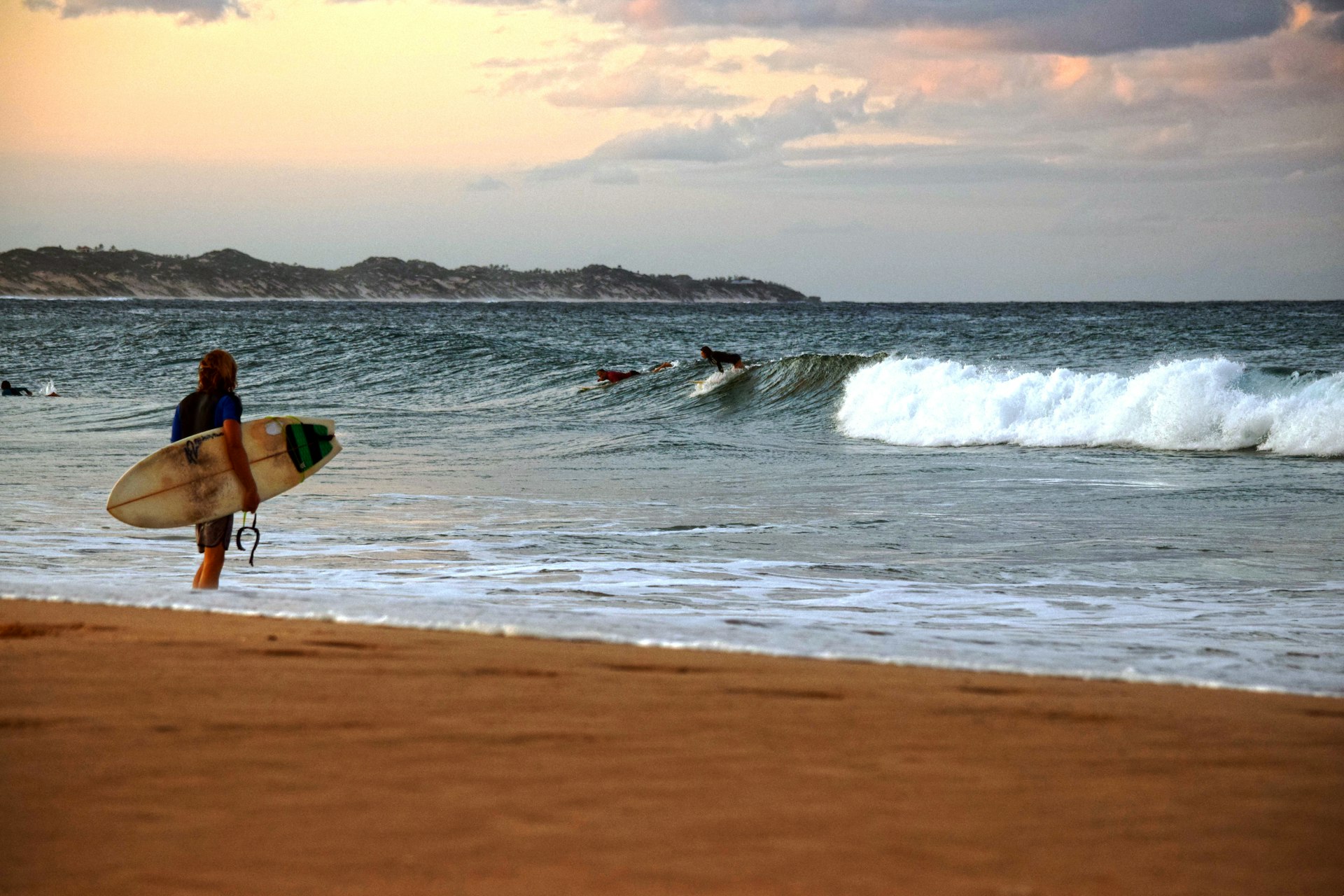
Tofo has a functional surf break suitable for intermediate to advanced surfers; beginner surf lessons available through local operators. The exposed Indian Ocean position produces consistent swell. The casuarina-backed beach is beautiful regardless of whether you surf.
Eat piri-piri prawns at the beach
The Mozambican seafood tradition is nowhere more accessible than in Tofo, piri-piri prawns, Frango à Zambeziana, grilled crab, and fresh fish caught that morning by the local fishing community, served at beachside restaurants at prices significantly below what urban hotels charge for comparable quality.
Take Fatima's shuttle from Maputo
The standard budget access route. Fatima's Backpackers shuttle departs Maputo at 05:00, covering the 489km to Tofo in 7.5–9 hours for approximately 700 Meticais. Comfortable, direct, and social, many travellers form their Tofo connections on the bus journey itself.
When to Visit Tofo Beach & the Manta Coast
Optimal Diving
April, June
Post-cyclone season. Seas calm, visibility peaks, manta and whale shark activity at high levels. Ideal for serious diving in less crowded conditions than the September–November window.
Whale Shark Peak
October, February
Peak whale shark encounter rates, the warm-water plankton bloom drives the highest densities of the year. Cyclone risk increases from December (avoid January–February for severe weather risk). Water temperatures peak; visibility may reduce in heavy rain periods. Whale shark snorkelling is at its most reliable.
Spring Diving Peak
September, November
The second optimal diving window, warm water, good visibility, high marine life activity. The main South African dive season; book Tofo Scuba spots well in advance. Whale shark encounters are highly reliable from October.
Winter
July, August
Southern hemisphere winter. Cooler water (23–25°C) but excellent visibility and consistent manta encounters. Less crowded than peak diving windows. Pleasant air temperatures for non-divers.
Getting to Tofo Beach & the Manta Coast
By road from Maputo is 489km, approximately 7.5–9 hours via the N1 to Maxixe, then ferry or bridge crossing to Inhambane, then 22km to Tofo. Fatima's shuttle (departs 05:00, 700 Meticais) is the standard budget route. By air, fly Maputo to Inhambane Airport (INH) on LAM, approximately 1 hour; transfers from Inhambane to Tofo are a short road journey.
Where to Stay
Tofo Mar Lodge is a mid-range beachfront option, reliable, well-positioned, and connected to the dive operators. Baia Sonambula is a well-regarded mid-range beach lodge, good for both divers and non-diving companions. Fatima's Nest is the budget backpacker guesthouse associated with the Maputo shuttle service, the standard budget base. Four to seven nights for serious diving; three to four for general beach visits.
Travel Tips for Tofo Beach & the Manta Coast
Frequently Asked Questions
- Are the whale shark encounters really year-round?
- Yes, Tofo's whale sharks are residents, not seasonal visitors. Peak encounter rates run October–February (warm-water plankton bloom) but encounters happen in every month of the year. Reliability is one of Tofo's main differentiators from seasonal whale shark destinations like Mexico's Holbox.
- Do I need to be a certified diver?
- Not for whale sharks (snorkel-only). For manta cleaning station dives, yes. PADI Open Water certification can be completed in 3–4 days at Tofo Scuba, many travellers schedule the certification at the start of a longer Tofo stay so they can dive the manta sites afterwards.
- How does Tofo compare to the Bazaruto Archipelago?
- Different registers. Bazaruto is luxury island lodging with reef diving and dugong; Tofo is bohemian beach-town diving with whale sharks and mantas. Bazaruto is significantly more expensive; Tofo is accessible to almost any budget. The combination of both, 4–6 nights at Tofo for the diving, then a transfer up to Vilanculos for 4 nights at Bazaruto, is the optimal Mozambique coast itinerary.
- Is Tofo safe for solo travellers?
- Yes, with standard backpacker precautions. The town is small, the dive community is friendly and self-policing, and most accommodation is geared to solo and group travellers. Standard Mozambican urban precautions don't apply to the same degree in Tofo, it's a beach town, not a city.
Explore More, Tofo Beach & the Manta Coast
Plan Your Trip
More in Mozambique
Bazaruto Archipelago
Five islands and 1,260 square kilometres of protected Indian Ocean off Vilanculos. The last viable dugong population in the western Indian O…
Gorongosa National Park
The Mozambican national park whose 90%+ wildlife loss during the civil war has been reversed by a 20-year science-led restoration project. L…
Inhambane City
A 10th-century Swahili port that became a Portuguese colonial hub, now a quiet, palm-shaded city of layered colonial architecture, ancient m…
Maputo
Mozambique's harbour capital, wide, tree-lined avenues, an architectural heritage layering Arab, French, Portuguese, and African influences,…
Ilha de Moçambique
A 3km island off the Nampula coast that served as the capital of Portuguese East Africa for nearly 400 years. The Chapel of Nossa Senhora de…
Ponta do Ouro
Mozambique's southernmost coastal village, a short drive from the Kosi Bay border with South Africa. Ethical wild dolphin snorkelling with r…
Maputo National Park
Proclaimed in 2021, this Peace Parks-managed reserve combines coastal dune forest, lagoons, and grassland with a protected marine zone, habi…
Bilene & the Uembje Lagoon
A 27km calm-water lagoon separated from the Indian Ocean by sand dunes, the safest swimming destination on the Mozambican coast. Kiteboardin…
Quirimbas Archipelago
The Quirimbas Archipelago, 32 coral islands off northern Mozambique's Cabo Delgado coast, is currently subject to Level 4 "Do Not Travel" ad…