
Bazaruto Archipelago
Five islands and 1,260 square kilometres of protected Indian Ocean off Vilanculos. The last viable dugong population in the western Indian Ocean, world-class coral reef diving, year-round humpback whale migration, and the most exclusive eco-resorts on the African coast.
Mozambique's Crown Jewel Marine Park
Photo by Pat Sakellari on Unsplash
About Bazaruto Archipelago
The boat to Bazaruto takes you away from everything within the first twenty minutes. The water colour changes, from the grey-green of the mainland shallows to a succession of blues that become increasingly improbable as the depth drops away. By the time the island's sand dunes appear on the horizon, still distant but already dramatic, you have already left the world of phones, roads, and schedules behind. The Bazaruto Archipelago National Park encompasses five islands, Bazaruto, Benguerra, Magaruque, Santa Carolina, and Bangué, strung across 1,260 square kilometres of protected Indian Ocean off the coast of Vilanculos. The marine park was established specifically to protect what the conservation community understood to be something extraordinary and increasingly rare: an intact, functioning coral reef system in the western Indian Ocean, still supporting populations of animals that have been extirpated from virtually every comparable site on the coast.
The dugong is the most emblematic of these, the last viable population of this gentle, slow-moving marine mammal in the western Indian Ocean survives in the seagrass beds of the archipelago. Sighting one, surfacing briefly between dives, then descending again into the turquoise water above the reef, is an encounter with a species most of the Indian Ocean coast has already lost. There are estimated to be 250–350 dugong remaining in the archipelago's protected waters, a number simultaneously heartening and sobering. The reefs themselves span a range of difficulty, Two Mile Reef (the celebrated 14m star site with its "Aquarium" of fish density and reliable manta encounters), Magaruque Reef for beginners, Linene at 30m for advanced divers, and Marlin Pinnacle at 37m for technical specialists, concentrated primarily around the outer reef systems.
From June to November, humpback whales migrating from Antarctic feeding grounds to the warm Mozambique Channel pass through the archipelago in numbers that make surface sightings a near-daily occurrence. Breaching whales visible from lodge terraces and boat decks are one of Bazaruto's defining seasonal spectacles. Beyond the diving, traditional dhow sailing between the islands, sandbank picnics on strips of white sand in the middle of the Indian Ocean, deep-sea fishing for marlin and sailfish, and cultural visits to the resident island villages round out a destination that genuinely rewards 4–6 nights minimum. The luxury anchors, Anantara Bazaruto Island Resort and Azura Benguerra Retreats, set a standard that ranks among the best beach lodges anywhere in Africa, with helicopter transfers, world-class spas, and marine programming that justifies the very real prices.
Things to Do in Bazaruto Archipelago
Dive Two Mile Reef
The archipelago's signature site, a 14m-average system featuring "The Aquarium," a section of extraordinary fish density and coral diversity. Giant manta rays, reef sharks, and the occasional dugong make this a site divers return to repeatedly. Located 16 nautical miles from the main base; full-day boat trips are standard.
Encounter the dugong
The last viable western Indian Ocean dugong population grazes on seagrass beds in shallow water, typically early morning and late afternoon. Sightings are not guaranteed, the archipelago is vast and the animals range widely, but encounter rates from dedicated boat searches are meaningful enough that most multi-night guests see one. An encounter with a species most of the coast has lost.
Sail a traditional dhow
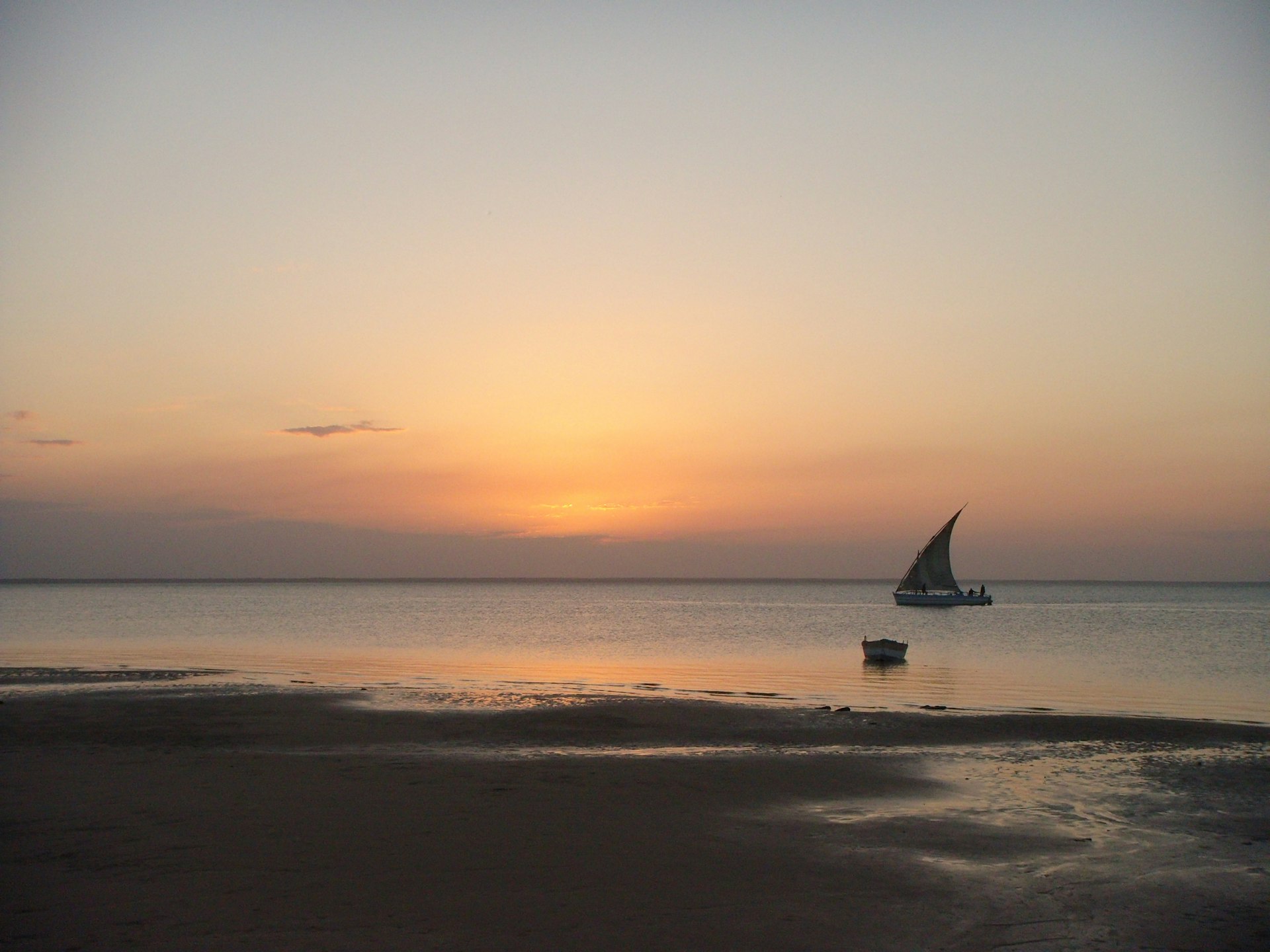
Wooden dhows, the same vessel type Arab traders used on these waters a thousand years ago, provide the most atmospheric inter-island transport. Sunset cruises, fishing excursions, and inter-island day trips all utilise these vessels, crewed by local fishermen with deep generational knowledge of the Mozambique Channel.
Picnic on a tidal sandbank
Some of the archipelago's sandbanks appear and disappear with the tide. Picnic provisions transported by dhow to a strip of white sand in the middle of the Indian Ocean, with the coral reef visible through gin-clear water on all sides. One of the more surreal experiences on offer in southern Africa.
Watch for humpback whales
From June to November, humpbacks migrating from Antarctic feeding grounds to the Mozambique Channel pass through the archipelago in numbers that make surface sightings a near-daily occurrence. Breaching whales visible from lodge terraces and boat decks. Specialised whale-watching boat trips operate during peak migration.
Stay at Anantara or Azura
The luxury island anchors. Anantara Bazaruto Island Resort delivers villas with private pools, a world-class spa, and helicopter transfers from Vilanculos. Azura Benguerra Retreats is a more intimate boutique eco-resort with exceptional marine programming and a strong community conservation ethos. Both rank among the best beach lodges anywhere in Africa.
When to Visit Bazaruto Archipelago
Spring Diving Peak
September, November
The optimal all-round window. Post-winter, pre-cyclone; settled seas, maximum visibility (20m+), warm water, and humpback whales still present in the channel. Lodge availability fills 6–12 months ahead for this period; book early. Light winds and calm conditions for dhow sailing.
Autumn Diving Peak
April, June
The other optimal window. Water clarity at maximum after the green season ends; cooler than November but with whale season beginning from June. Slightly fewer crowds than the September–November peak. Excellent for travellers who want serious diving in less crowded conditions.
High Season
July, August
Peak dry-season comfort with good conditions and humpback whales reliably present. Busier lodge occupancy and higher rates than the shoulder peaks. Still excellent for first-time Bazaruto visitors.
Cyclone Risk
January, February
Cyclone season, the Bazaruto coast has been directly hit by tropical cyclones, including the catastrophic Cyclone Idai in 2019. If travelling during this period, ensure your booking has full weather-related cancellation flexibility. Most travellers avoid this window entirely.
Getting to Bazaruto Archipelago
Reaching Vilanculos (VNX) is the first step, domestic flights from Maputo on LAM and Fastjet take approximately 1 hour. The road from Maputo covers 470km and takes 7+ hours self-drive, viable but long. From Vilanculos, speedboat transfers to the islands take 30–45 minutes; lodges arrange these directly. Charter flights from Vilanculos airstrip to island airstrips are available for guests preferring to skip the boat crossing. The Safari Air Gorongosa–Vilanculos route (Mondays and Wednesdays) makes combining a Gorongosa safari with Bazaruto practical for the first time.
Where to Stay
Anantara Bazaruto Island Resort on Bazaruto Island is the archipelago's landmark luxury property, villas with private pools overlooking the ocean, a world-class spa, and guided snorkelling and diving programmes. Azura Benguerra Retreats on Benguerra Island is a boutique eco-resort, slightly more intimate, highly regarded for guiding and marine encounter programming. Santa Carolina (Paradise Island) is the smallest island, historically maintained as a day-excursion destination from the mainland. Four to six nights minimum to do justice to the diving, whale watching, and dhow excursions; book 6–12 months ahead for peak season.
Travel Tips for Bazaruto Archipelago
Frequently Asked Questions
- How does Bazaruto compare to the Maldives or Zanzibar?
- Different scales and characters. The Maldives is more developed, with thousands of resorts; Zanzibar is busier and more accessible. Bazaruto is smaller in volume but with a stronger conservation ethos, more intact reefs, and the dugong as a unique drawcard. For travellers who have already done the Maldives or Zanzibar and want a more remote, more conservation-focused alternative, Bazaruto delivers, at significantly higher per-night prices for the top properties.
- Are the dugong sightings reliable?
- Reasonably so over a multi-day visit. Single-day visitors should not expect to see one; 4–6 night guests with dedicated boat searches typically encounter at least one dugong during their stay. The animals are wild and range widely. The encounter, when it happens, is brief and remarkable.
- Is Bazaruto suitable for non-divers?
- Yes. The snorkelling on the inner reefs is excellent, dhow sailing is the iconic activity, and the lodges are designed for the full beach-luxury experience whether you dive or not. Many couples have one diver and one non-diver, both fully entertained.
- How does the cyclone risk affect planning?
- Cyclones primarily affect January–February. Cyclone Idai (March 2019) and subsequent storms have caused significant damage. Travel during October–December and April–June carries minimal cyclone risk; January–February requires close weather monitoring and flexible bookings. The lodges have rebuilt extensively post-Idai.
Explore More, Bazaruto Archipelago
Plan Your Trip
More in Mozambique
Gorongosa National Park
The Mozambican national park whose 90%+ wildlife loss during the civil war has been reversed by a 20-year science-led restoration project. L…
Tofo Beach & the Manta Coast
A laid-back beach town 22km east of Inhambane on the Manta Coast, sustained by the plankton-rich Mozambique Current that brings whale sharks…
Inhambane City
A 10th-century Swahili port that became a Portuguese colonial hub, now a quiet, palm-shaded city of layered colonial architecture, ancient m…
Maputo
Mozambique's harbour capital, wide, tree-lined avenues, an architectural heritage layering Arab, French, Portuguese, and African influences,…
Ilha de Moçambique
A 3km island off the Nampula coast that served as the capital of Portuguese East Africa for nearly 400 years. The Chapel of Nossa Senhora de…
Ponta do Ouro
Mozambique's southernmost coastal village, a short drive from the Kosi Bay border with South Africa. Ethical wild dolphin snorkelling with r…
Maputo National Park
Proclaimed in 2021, this Peace Parks-managed reserve combines coastal dune forest, lagoons, and grassland with a protected marine zone, habi…
Bilene & the Uembje Lagoon
A 27km calm-water lagoon separated from the Indian Ocean by sand dunes, the safest swimming destination on the Mozambican coast. Kiteboardin…
Quirimbas Archipelago
The Quirimbas Archipelago, 32 coral islands off northern Mozambique's Cabo Delgado coast, is currently subject to Level 4 "Do Not Travel" ad…