
Gorongosa National Park
The Mozambican national park whose 90%+ wildlife loss during the civil war has been reversed by a 20-year science-led restoration project. Lions, wild dogs, 700+ elephants, and Mount Gorongosa's montane forest in central Mozambique.
Africa's Greatest Rewilding Story
Photo by Peter Thomas on Unsplash
About Gorongosa National Park
The statistics are stark. Before Mozambique's civil war, Gorongosa National Park was one of the greatest wildlife destinations in Africa, the "Serengeti of the South," host to vast herds of buffalo, hippo, and wildebeest, and the predators that followed them. By the time the 1992 peace accords were signed, over 90% of the large mammal population had been slaughtered, for food, ivory, and by both sides' combatants during seventeen years of conflict through the park's territory. Buffalo reduced from an estimated 14,000 to fewer than 100. Hippo from 3,500 to 44. Wildebeest nearly gone entirely. What has happened since is one of the most consequential conservation projects in African history.
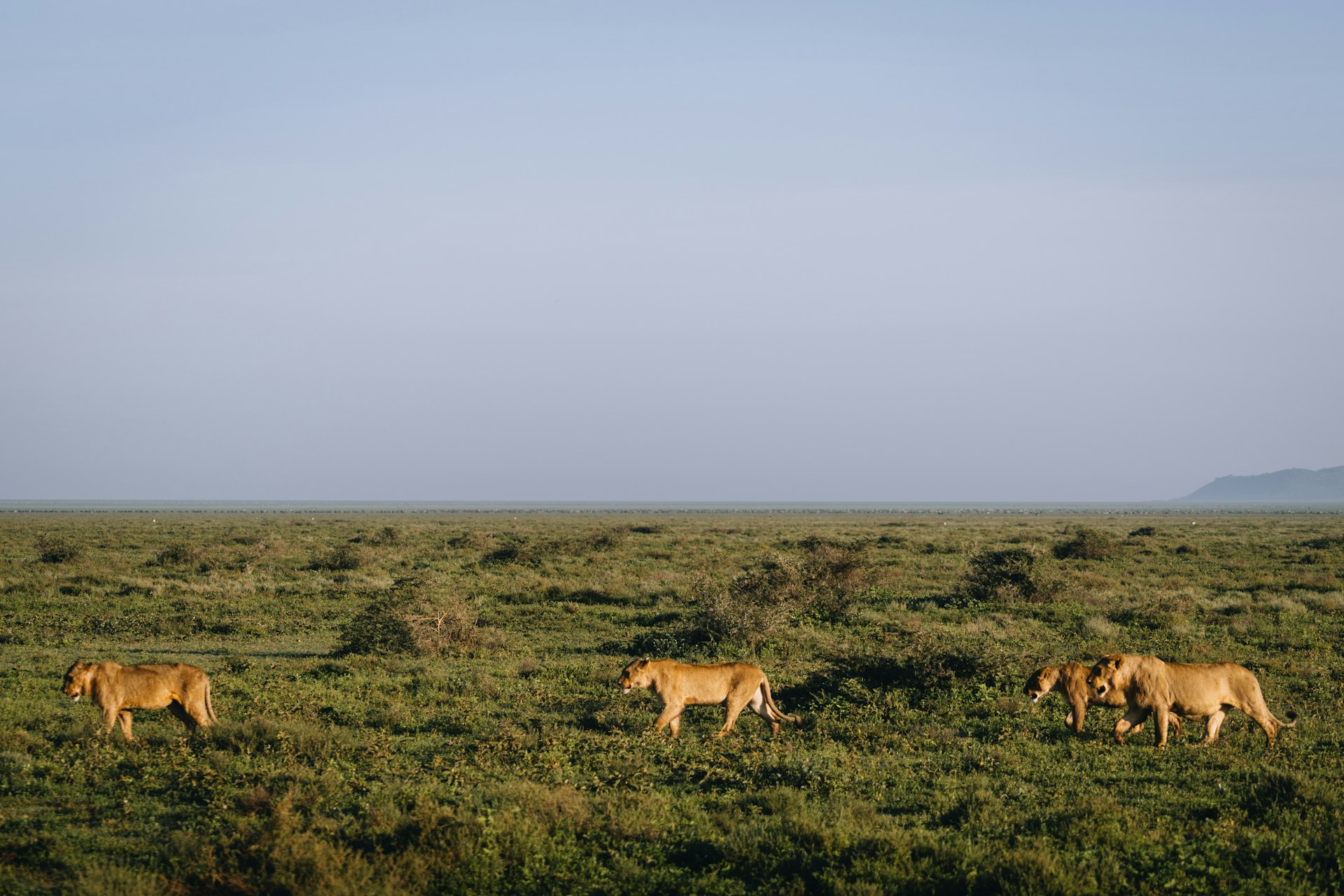
The Gorongosa Restoration Project, a long-term, science-led public-private partnership initiated in earnest from 2004 with the involvement of American philanthropist Greg Carr, has systematically rebuilt the park's ecology from near-zero. Lions were reintroduced and now maintain breeding populations. Wild dog packs have naturally colonised from adjacent conservation areas. Elephants have grown from fewer than 200 in the 1990s to over 700, though the social trauma of the conflict period is still legible in the elephants' behaviour patterns, documented by researchers who have studied the population continuously and identified evidence of multigenerational trauma in elephant societies. A major ongoing scientific programme has documented dozens of species new to science within the park's boundaries, including invertebrates, birds, and botanical species.
Gorongosa is not simply a recovered park. It is a living demonstration that rewilding is possible, that ecosystems retain sufficient resilience, given adequate protection and investment, to reconstitute themselves. Visiting here is not passive wildlife tourism; it is witnessing an ongoing experiment with one of the most important questions in conservation science. The core game-drive circuit covers the main savannah, the Lake Urema floodplain (one of Africa's most productive waterbird habitats with 500+ recorded species), and the dry woodland ridges. Mount Gorongosa at 1,863m, the park's highest point and primary water catchment, adds a montane forest dimension distinct from the lowland savannah, with endemic species and extraordinary botanical interest. The lodges actively facilitate engagement with the Restoration Project, visiting the research centre, meeting field scientists, that transforms the experience from wildlife viewing into conservation participation.
Things to Do in Gorongosa National Park
Game drive the savannah and floodplain
The core circuit covers the main savannah, the productive Lake Urema floodplain, and the dry woodland ridges where predators patrol at dawn and dusk. Low visitor density, a direct consequence of the park's rebuilding phase and relative obscurity, means wildlife encounters are unmediated by vehicle competition.
Walking safari with a research-trained guide
Guides at Gorongosa are among Mozambique's most knowledgeable ecological interpreters, many trained by the Restoration Project's scientific team and deeply versed in both the conservation history and the current research programmes. Walking safaris focus on plant identification, spoor reading, and understanding the ecosystem at ground level.
Night drive for nocturnal species
Night drives within the park's concession areas reveal the nocturnal ecosystem: civets, genets, African wild cats, and the porcupines that trundle through the darkness in their armoured improbability. Lions and leopards are significantly more active at night; post-dusk drives substantially increase sighting frequency.
Hike Mount Gorongosa
The park's highest point at 1,863m is an ecological entity distinct from the lowland savannah, a montane forest ecosystem that acts as primary water catchment for the entire park. Guided day hikes pass through multiple vegetation zones; the mountain's forests harbour endemic species and extraordinary botanical interest.
Engage with the Restoration Project
Unlike most safari destinations, Gorongosa's lodges actively facilitate direct engagement with the conservation and community programmes, visiting the research centre, meeting scientists, and understanding the mechanisms producing the park's recovery. Optional but transformative, turns the experience into conservation participation.
Bird the Lake Urema floodplain
Gorongosa's avian diversity is extraordinary, over 500 recorded species, including multiple endemic and near-endemic. Lake Urema is among the most productive waterbird habitats in Mozambique: wattled crane, saddle-billed stork, African fish eagle, Bohm's bee-eater, and dozens of other species concentrated around the water's edge.
When to Visit Gorongosa National Park
Cool Dry
May, July
The most comfortable game-viewing window. Cooler temperatures, vegetation thinning, and wildlife beginning to concentrate around water sources. Walking safaris are at their most pleasant. Low malaria risk relative to the wet season but prophylaxis remains essential.
Late Dry
August, October
Peak game-viewing intensity. The Lake Urema floodplain shrinks dramatically; wildlife concentrates around the remaining water. Hot days; September–October regularly exceeds 35°C. Predator activity increases as competition for water peaks.
Closed/Inaccessible
November, April
The wet season makes most of Gorongosa's roads impassable. Most camps close. The park is not a viable destination for mainstream tourism in this window. Birding is exceptional with migrants arriving in force, but logistics defeat most casual visitors.
Getting to Gorongosa National Park
Fly to Beira (BEW) from Maputo (LAM, approximately 1 hour) then road transfer to the park (~3 hours). This is the standard access route. The dedicated Safari Air Gorongosa–Vilanculos route (Mondays and Wednesdays, ~USD 620 one-way, strict 15kg soft-bag limit) has transformed the logistics of combining a Gorongosa safari with a Bazaruto beach stay. By road from Maputo is approximately 900km and 10+ hours, practical only for overlanders or travellers with multiple days on the road.
Where to Stay
Chitengo Camp is the park's main camp, comfortable safari accommodation at park headquarters near the research centre and multiple research facilities, the primary base for most visitors. Musikmu Bush Camp is an exclusive, intimate tented camp within the park's interior concession, with limited guest numbers and exceptional privacy and immersion, the most experiential accommodation option. Three to four nights covers the activity range comfortably; combining with Bazaruto via Safari Air's direct flight is the most rewarding Mozambique itinerary.
Travel Tips for Gorongosa National Park
Frequently Asked Questions
- Is Gorongosa a substitute for Kruger or Sabi Sands?
- No, and it shouldn't be approached as one. Gorongosa is a conservation experience, the recovery story is the headline, and the wildlife densities are still building. For travellers who have already done a major safari and want a different register, one focused on conservation participation rather than sighting frequency, Gorongosa is one of the most meaningful destinations in Africa.
- Are the elephants really showing trauma signs?
- Yes, researchers who have studied the population continuously since the war's end have documented behavioural patterns in elephants who experienced the conflict that differ from the population's younger members. The findings have shaped broader scientific understanding of multigenerational trauma in elephant societies. The lodge guides explain these dynamics with appropriate nuance.
- How does the Bazaruto combination work logistically?
- The Safari Air direct flight (Mon/Wed, ~USD 620 one-way) makes a Gorongosa–Bazaruto pairing genuinely practical for the first time. Three nights at Gorongosa plus 4–5 nights at Bazaruto is the optimal Mozambique itinerary. Without this flight, the combination required long road transfers via Maputo.
- How many days do I need at Gorongosa?
- Three to four nights minimum. Less than three risks missing a key activity (Mount Gorongosa hike, the Lake Urema floodplain, the research centre engagement). Five nights gives you the full experience plus rest. The pairing with Bazaruto extends naturally to 7–10 days.
Explore More, Gorongosa National Park
Things To Do
Plan Your Trip
More in Mozambique
Bazaruto Archipelago
Five islands and 1,260 square kilometres of protected Indian Ocean off Vilanculos. The last viable dugong population in the western Indian O…
Tofo Beach & the Manta Coast
A laid-back beach town 22km east of Inhambane on the Manta Coast, sustained by the plankton-rich Mozambique Current that brings whale sharks…
Inhambane City
A 10th-century Swahili port that became a Portuguese colonial hub, now a quiet, palm-shaded city of layered colonial architecture, ancient m…
Maputo
Mozambique's harbour capital, wide, tree-lined avenues, an architectural heritage layering Arab, French, Portuguese, and African influences,…
Ilha de Moçambique
A 3km island off the Nampula coast that served as the capital of Portuguese East Africa for nearly 400 years. The Chapel of Nossa Senhora de…
Ponta do Ouro
Mozambique's southernmost coastal village, a short drive from the Kosi Bay border with South Africa. Ethical wild dolphin snorkelling with r…
Maputo National Park
Proclaimed in 2021, this Peace Parks-managed reserve combines coastal dune forest, lagoons, and grassland with a protected marine zone, habi…
Bilene & the Uembje Lagoon
A 27km calm-water lagoon separated from the Indian Ocean by sand dunes, the safest swimming destination on the Mozambican coast. Kiteboardin…
Quirimbas Archipelago
The Quirimbas Archipelago, 32 coral islands off northern Mozambique's Cabo Delgado coast, is currently subject to Level 4 "Do Not Travel" ad…