
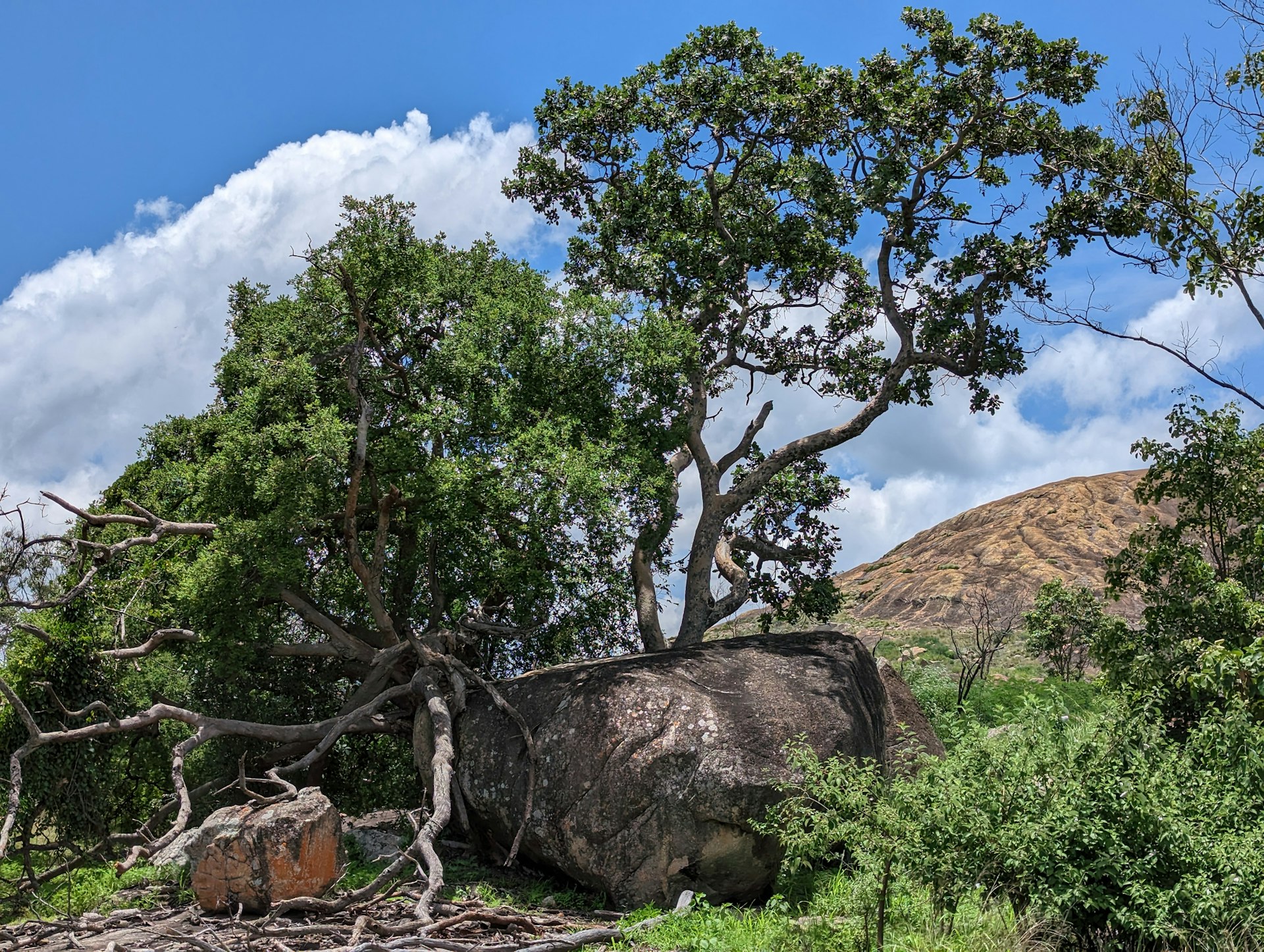
Matobo Hills
A UNESCO World Heritage landscape of impossibly balanced granite boulders, ancient San rock art, and one of the densest leopard populations in Africa. Matobo is also the best place in Zimbabwe to track black and white rhino on foot.
Balancing Rocks, Rock Art, and Rhino on Foot
Photo by Oliver Bradley on Unsplash
About Matobo Hills
The Matobo Hills are one of the most distinctive landscapes in southern Africa, a 3,000 square kilometre expanse of weathered granite where two billion years of erosion have left great rounded domes (called "dwalas") and improbably balanced boulders standing on top of one another like stacked stones. The hills were sacred to the San people who lived here for tens of thousands of years, and the rock shelters they used hold one of the richest concentrations of rock art anywhere in the world, over 3,000 documented sites, with paintings up to 13,000 years old depicting elephant, giraffe, hunting scenes, and ceremonial figures.
The Matobo National Park, at the heart of the broader UNESCO site, is small by African standards (424 square kilometres) but exceptional for two things. The first is rhino: Matobo holds one of Zimbabwe's most successful rhino sanctuaries, with both black and white rhino in healthy numbers, and the rhino tracking on foot, led by armed scouts who know the animals individually, is one of the most accessible and reliable rhino experiences in southern Africa. The second is leopard density: the Matobo's broken granite habitat is exceptional leopard country, and the park reportedly has one of the highest leopard concentrations in Africa, though the cats are characteristically elusive.
The hills also hold deep spiritual significance for the Ndebele and Shona people, and continue to be used for traditional ceremonies. The grave of Cecil John Rhodes, controversially located here at his own request, on a granite outcrop he named World's View, is part of the site's complicated colonial legacy. Matobo is an easy hour's drive south of Bulawayo, Zimbabwe's second city, and is most commonly visited as a one or two-night extension to a Hwange-and-Victoria Falls safari. For travellers interested in landscape, prehistory, and walking-based wildlife experiences, it is one of the most under-rated stops in the region.
Things to Do in Matobo Hills
Track black and white rhino on foot
Matobo's signature experience. Armed scouts lead small groups on foot to find rhino at close range, both species are present, and sightings are reliable thanks to the rangers' detailed knowledge of individual animals. One of the most accessible foot-rhino experiences anywhere in Africa.
Visit the rock art at Nswatugi or Bambata
Two of the most accessible of the Matobo's 3,000 documented rock-art sites. Nswatugi has elegant San paintings of giraffe, kudu, and human figures, in a deep granite shelter that's a short walk from the road. Bambata and Silozwane are further afield and more atmospheric. A guided visit explains the symbolism and the dating.
Climb a dwala for sunset
The granite domes are climbed by walking, they're steep but not technical, and the view from the top across the broken landscape of balancing boulders is one of the great African landscape experiences. World's View, near Cecil Rhodes' grave, is the most accessible. Local guides know quieter, more dramatic alternatives.
Look for leopard at dawn
Matobo has one of the highest leopard densities in Africa, but the cats are exceptionally elusive in the broken granite habitat. Early morning game drives with experienced guides give the best chance, even brief sightings are special given how rarely the species is seen elsewhere.
Visit Cecil Rhodes' grave at World's View
Controversial and historically significant, the British colonialist's grave is set into the granite at a viewpoint he chose himself. The site is a useful prompt for conversations with Zimbabwean guides about colonial history, restitution debates, and the broader spiritual significance of the Matobo to the Ndebele and Shona.
Spend an evening at a community cultural village
Several community-run initiatives near the park offer evening dinners, traditional dance, and conversation about Ndebele history and the spiritual role of the Matobo. Done well, these are far from the standard tourist cultural-village experience and often the most memorable part of a Matobo visit.
When to Visit Matobo Hills
Cool Dry
May, August
The best window for walking-based activities. Days are sunny and mild, the granite domes aren't punishingly hot, and the bush is open enough to see wildlife well. Mornings are cold, frost is possible on the higher dwalas in June and July.
Warm Dry
September, October
Hot during the day, especially on the granite, but rhino tracking is still reliable and the bush is at its most open. Late October can be intensely hot, start early. Wildlife concentrates around remaining water sources.
Green Season
November, March
The rains transform the granite landscape, water collects in pans on top of the dwalas, the surrounding miombo woodland flushes deep green, and dramatic skies make for striking photography. Some rock art sites become harder to access. Lower prices and far fewer visitors.
Getting to Matobo Hills
Matobo is an hour's drive south of Bulawayo, Zimbabwe's second city. Joshua Mqabuko Nkomo International Airport (BUQ) outside Bulawayo has daily flights from Johannesburg and Harare. Most visitors fly into Bulawayo, hire a transfer or self-drive south on the tarred road to the park, and stay one or two nights at one of the lodges on the park boundary. Some operators arrange transfers from Hwange or Victoria Falls, Matobo combines well at the start or end of a western Zimbabwe safari loop.
Where to Stay
Accommodation around Matobo is modest in scale but high in atmosphere. Big Cave Camp, perched on a granite kopje overlooking the park, is the most architecturally distinctive, thatched suites built into the rocks themselves with views over the Matobo landscape. Camp Amalinda offers a similar boulder-set setting with a strong cultural programme. Matobo Hills Lodge is a more conventional lodge option closer to the park gate. For self-drivers, Maleme Rest Camp inside the park offers basic chalets and excellent access for early-morning rhino tracking.
Travel Tips for Matobo Hills
Frequently Asked Questions
- Why is Matobo a UNESCO World Heritage site?
- For its combination of geological, cultural, and spiritual significance. The granite landscape itself is one of the most distinctive on Earth, the rock art is among the richest concentrations in the world (over 3,000 sites with paintings up to 13,000 years old), and the hills have continuous spiritual significance to the Ndebele and Shona peoples that goes back thousands of years.
- How likely am I to see rhino on a foot tracking experience?
- Very likely, Matobo has one of the most reliable foot-rhino experiences in Africa thanks to the small size of the sanctuary, the dedicated scouts who track individual animals daily, and the relatively healthy population of both black and white rhino. Most operators report sightings on more than 90 per cent of tracking outings.
- How does Matobo combine with the rest of a Zimbabwe trip?
- It pairs naturally with Hwange and Victoria Falls. A common loop is to fly into Bulawayo, spend two nights at Matobo, drive or fly to Hwange for three nights, then transfer to Victoria Falls for two or three nights and fly out. Adding Matobo to a classic Hwange-Vic Falls trip adds a different landscape, culture, and rhino on foot.
- Is Matobo safe?
- Yes. The park is well-managed, the lodges are reputable, and Bulawayo is one of the safest cities in Zimbabwe. Rhino tracking is conducted by armed scouts and follows strict protocols. As elsewhere in Zimbabwe, standard travel precautions apply, don't display valuables, use established operators, and avoid long-distance driving after dark.
Explore More, Matobo Hills
Plan Your Trip
More in Zimbabwe
Hwange National Park
Zimbabwe's largest national park and one of Africa's great elephant strongholds. Over 40,000 elephants roam Hwange's pump-fed waterholes alo…
Mana Pools National Park
A UNESCO World Heritage Site on the Zambezi floodplain where elephants stand on their hind legs to reach acacia branches and walking safaris…
Victoria Falls (Zimbabwe Side)
The Zimbabwe side of Victoria Falls offers the broadest panoramic views of all 1.7 kilometres of cascading water, across 16 viewpoints conne…
Great Zimbabwe
The largest stone structure in sub-Saharan Africa south of the pyramids. Built between the 11th and 15th centuries without mortar, Great Zim…
Lake Kariba & Matusadona
An inland sea created by one of the world's largest dams, where elephants swim between islands and houseboats double as floating safari lodg…
Eastern Highlands
A 300-kilometre belt of cool, green mountain country running along Zimbabwe's border with Mozambique. Hiking, fly-fishing, endemic birds, an…
Gonarezhou National Park
Zimbabwe's most remote major wilderness, in the country's southeastern corner. Big-tusked elephants, the dramatic red sandstone Chilojo Clif…
Bulawayo
Zimbabwe's unhurried second city, founded on the site of the Ndebele royal kraal and gateway to the Matobo Hills. Wide colonial-era avenues,…
Harare
Zimbabwe's leafy capital and primary international entry point. The National Gallery's Shona stone sculpture collection, accessible rock art…