
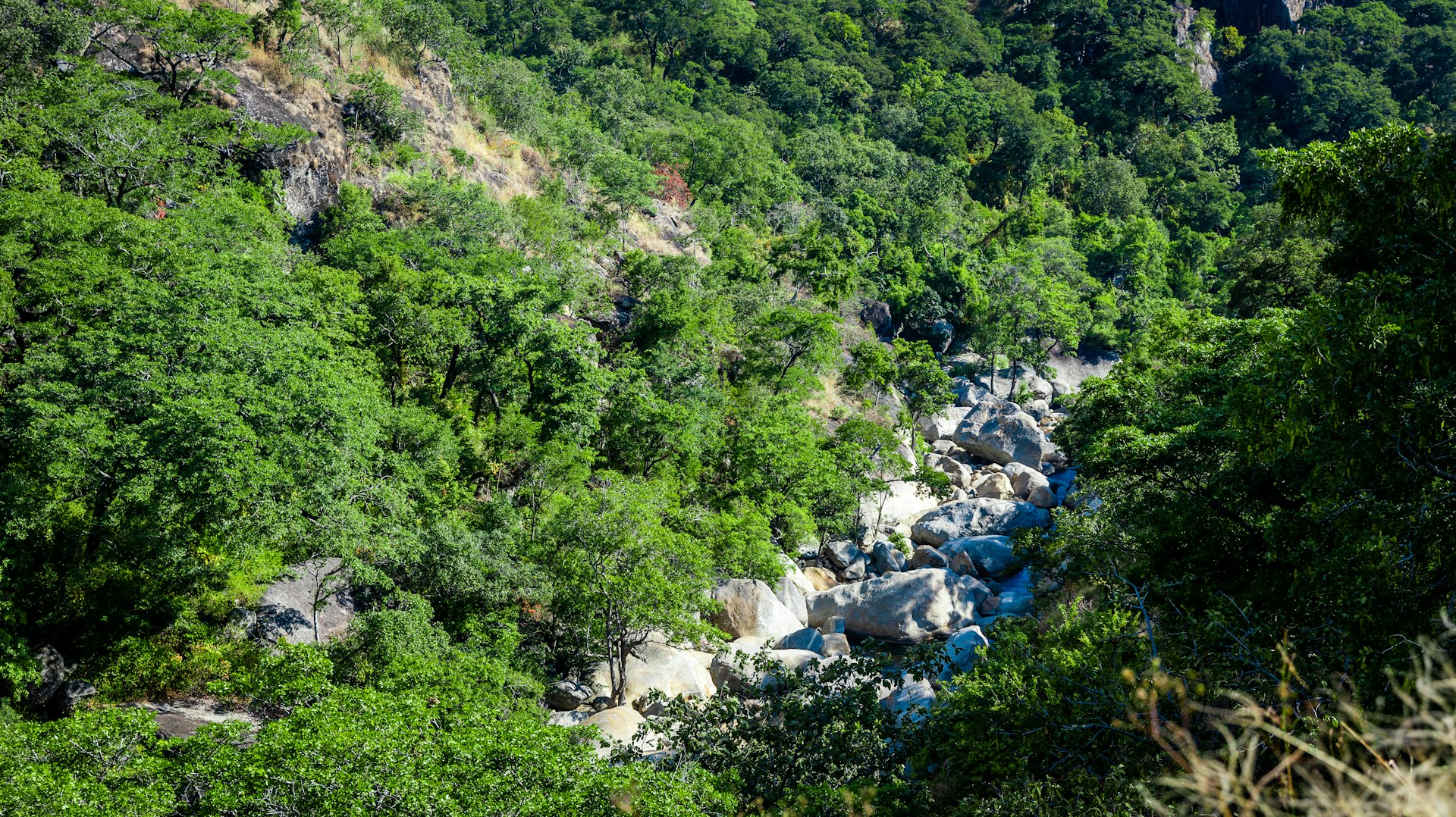
Mount Mulanje
A 3,002-metre granite massif rising abruptly from the tea estates of southern Malawi. Twenty distinct peaks, the critically endangered Mulanje Cedar, a forestry-hut network, and Sapitwa, the highest point in central Africa.
Central Africa's Premier Trekking Massif
Photo by Omar Hakeem on Unsplash
About Mount Mulanje
The approach to Mulanje is one of the great visual introductions in southern African travel. You are driving through the emerald orderliness of working tea estates, row after row of cultivated bushes covering the gently sloping foothills, when the massif simply appears above the cloud line. A wall of bare granite. Sheer rock faces rising 2,000 metres from the valley floor. Twenty distinct peaks. The highest, Sapitwa, at 3,002 metres, the top of the country and the highest point in central Africa. There is no gradual build-up. Mulanje erupts from the landscape with the abruptness of a geological statement, and the effect is startling regardless of how many photographs you have seen beforehand.
The Mount Mulanje Massif is the premier trekking destination in central Africa, a complex of peaks, plateaux, gorges, and river-carved valleys that accommodates everything from a two-hour waterfall walk to a four-day technical summit attempt. The Mulanje Cedar forests that cling to the gorge interiors are among the most critically endangered endemic tree communities in the world; walking through a healthy Cedar stand is an encounter with something genuinely rare and globally significant. The forestry hut network, Chambe, Thuchila, Chisepo, Sombani, Minunu, provides overnight staging points for multi-day traverses. And the working tea estates of the Satemwa plantation at the mountain's base provide a culturally and historically immersive frame for the experience: Huntingdon House, the estate's colonial country house, now operates as a small luxury guesthouse with breakfasts on the veranda and Mulanje filling the horizon.
The routes range from the 1.5-hour Likhubula Falls return (suitable for general fitness without specialist equipment) to the Sapitwa summit attempt, a serious mountain day involving scrambling, the exposed Knife Edge gully, and extended sections of bare granite slab requiring both hands. A guide is mandatory for any route above the plateau base, hired through the Mountain Club of Malawi at Likhubula Forest Station. The mountain creates its own weather; afternoon mist and rain are common even in the dry season; the granite is unforgiving when wet. Mulanje rewards preparation, respect, and the willingness to engage with a landscape that does not concede ground easily.
Things to Do in Mount Mulanje
Likhubula Falls day walk
The most accessible introduction to the massif, a 1.5 to 2-hour return trip from Likhubula Forest Station to a waterfall set in dense forest on the lower slopes. Suitable for general fitness levels; a pleasant half-day without committing to a multi-day trek. The route for visitors who want Mulanje's atmosphere without the hut-network commitment.
Two-night Chambe Plateau trek
The most popular multi-day route, a 4–5 hour moderate climb from Likhubula to Chambe Hut on the plateau at 1,800 metres. Basic self-catering accommodation (mattresses, basic cooking equipment, firewood). From Chambe, day hikes across the plateau, views down the sheer Chambe Face, and botanical walks through the Cedar forest pockets are the primary activities.
Sapitwa summit attempt
Sapitwa Peak (3,002m) is not a walk. The ascent involves serious scrambling, including navigation of the steep, exposed Knife Edge gully and extended sections of bare granite slab requiring both hands. Typically requires an overnight at Thuchila Hut followed by an early start for the final push. Total: 3–4 days from the base. Mandatory: an experienced guide, rigid-soled boots, and competent scrambling ability.
Walk the Mulanje Cedar forest
The Mulanje Cedar (Widdringtonia whytei) is a large, aromatic conifer endemic to the massif, it grows nowhere else in the world. The Cedar forests in the deeper gorges around Chambe, Thuchila, and Chisepo are among the most atmospheric forest experiences in southern Africa: tall, straight trunks rising through mist in ancient groves, the distinctive cedar fragrance permeating the air.
Multi-day traverse Likhubula to Minunu
For experienced trekkers seeking a multi-day wilderness experience, the traverse crossing the massif covers multiple huts, dramatic varied terrain, and the full ecological range in 4–6 days. Cedar forest, open plateau, deep river gorges, and high summit ridges. Mulanje's most comprehensive route.
Tour Satemwa Tea Estate
The historic Satemwa Tea Estate at the base of Mulanje provides one of Malawi's most immersive pre- or post-trek experiences. Huntingdon House, the estate's colonial country house, now operates as a small luxury guesthouse. Guided tea estate tours walk the plantation rows, visit the processing facility, and taste through the estate's range from green to black to purple tea.
When to Visit Mount Mulanje
Peak Trekking
May, September
The dry season is the primary trekking window. Clear skies provide the best summit views, dry paths make the technical sections safer, and the absence of rain reduces the risk of disorienting mist on the upper plateau. July and August are the most comfortable, cool but not cold at altitude.
Late Dry
October
Warm but still dry. Good conditions; slightly busier on popular routes. The pre-rain visibility can produce exceptional clarity for summit views, though afternoon thunderstorms become more frequent toward month end.
Wet Season
November, April
The rains make several routes extremely slippery, particularly the bare granite sections. Summit attempts are significantly more dangerous in wet conditions. Lower routes (Likhubula Falls, Chambe lower section) remain viable with appropriate footwear. The massif is dramatically beautiful in the rain, but the technical routes are only for experienced mountain travellers with proper wet-weather gear.
Getting to Mount Mulanje
From Blantyre to Likhubula Forest Station (the main trekking base) is approximately 65km, 1.5 hours via the M2 through Thyolo. The road is tarred throughout; standard vehicles are adequate. Likhubula is well signposted from Mulanje town. From Lilongwe expect approximately 4.5 hours via Blantyre. Huntingdon House on Satemwa Estate is 30km from Likhubula and serves as the pre/post-trek luxury base; self-catering guesthouses in Mulanje town serve budget travellers.
Where to Stay
Huntingdon House on the Satemwa Tea Estate is the most characterful base, a colonial country house furnished with genuine antiques from the estate's history, mature gardens with views toward the massif, and breakfasts on the veranda with freshly brewed Satemwa tea. The Likhubula Forest Resthouse provides basic accommodation at the trailhead itself. On the mountain, the forestry huts (Chambe, Thuchila, Chisepo, Sombani, Minunu) are self-catering and must be reserved through the Forestry Office in Mulanje town before the trek, bring all food, cooking fuel, and sleeping equipment.
Travel Tips for Mount Mulanje
Frequently Asked Questions
- Is Sapitwa achievable for fit hikers without mountain experience?
- Genuine fitness is necessary but not sufficient. The Knife Edge section involves exposure to significant drops on both sides and requires competent scrambling ability, a willingness to use both hands on rock, comfort with mild exposure, and the judgment to know when to retreat. First-time mountain travellers should consider Chambe Plateau as the more appropriate Mulanje experience.
- How does Mulanje compare to other African mountains?
- Smaller in absolute height than Kilimanjaro, Mt Kenya, or the Rwenzoris, but technically more demanding than Kilimanjaro's standard route. Mulanje is more like the Drakensberg in character, dramatic granite scenery, multi-day hut traverses, and serious summit scrambling, than the volcanic giants of East Africa. For trekkers who prefer rock to ice, Mulanje is one of the most rewarding African mountains.
- What about the Cedar?
- Mulanje Cedar is critically endangered, illegal harvesting (the timber is extremely valuable), fire, and invasive Mexican pine plantations have all reduced the population dramatically. The Cedar groves remaining in the deeper gorges are globally significant; conservation organisations are actively working on restoration. Visitors who walk through the Cedar with an informed guide become advocates for its protection.
- How long should I plan for Mulanje?
- Two days minimum for a Likhubula Falls day walk plus a Satemwa visit, the lighter introduction. Four days for a Chambe Plateau two-night trek. Six to seven days for a Sapitwa attempt or a full traverse. Add Huntingdon House for one or two nights on either side as the recovery component.
Explore More, Mount Mulanje
Things To Do
Plan Your Trip
More in Malawi
Lake Malawi
A 580-kilometre UNESCO-inscribed rift lake holding more fish species than any other lake on earth. Snorkelling and diving on Cape Maclear's …
Liwonde National Park
Malawi's premier Big Five safari, transformed by African Parks from a depleted reserve into a functioning ecosystem with rhino tracking, boa…
Majete Wildlife Reserve
Malawi's first Big Five reserve, rebuilt from complete depletion by African Parks since 2003. Lions, black rhinos, elephants, leopards, buff…
Nyika National Park
Malawi's largest park, 3,134 square kilometres of high-altitude montane grassland averaging 2,000 metres. Roan antelope, leopards, 213 orchi…
Lilongwe
Malawi's primary international entry point and a sprawling, low-rise capital with a wildlife sanctuary in its centre, an Old Town market tha…
Nkhotakota Wildlife Reserve
Malawi's largest reserve and the recipient of the largest wildlife translocation in African history, 500 elephants and 2,000 other animals m…
Likoma Island
A 17-square-kilometre Malawian sovereign island in the middle of Mozambican lake waters. St Peter's Cathedral, completed 1905, larger in foo…
Zomba Plateau
An 1,800-metre forested plateau above Malawi's former colonial capital. Hiking and mountain biking on the forestry trail network, escarpment…
Livingstonia & Chongoni
Two cultural anchors at opposite ends of the Malawian timeline. Livingstonia, a 19th-century Scottish missionary town perched 700 metres abo…