
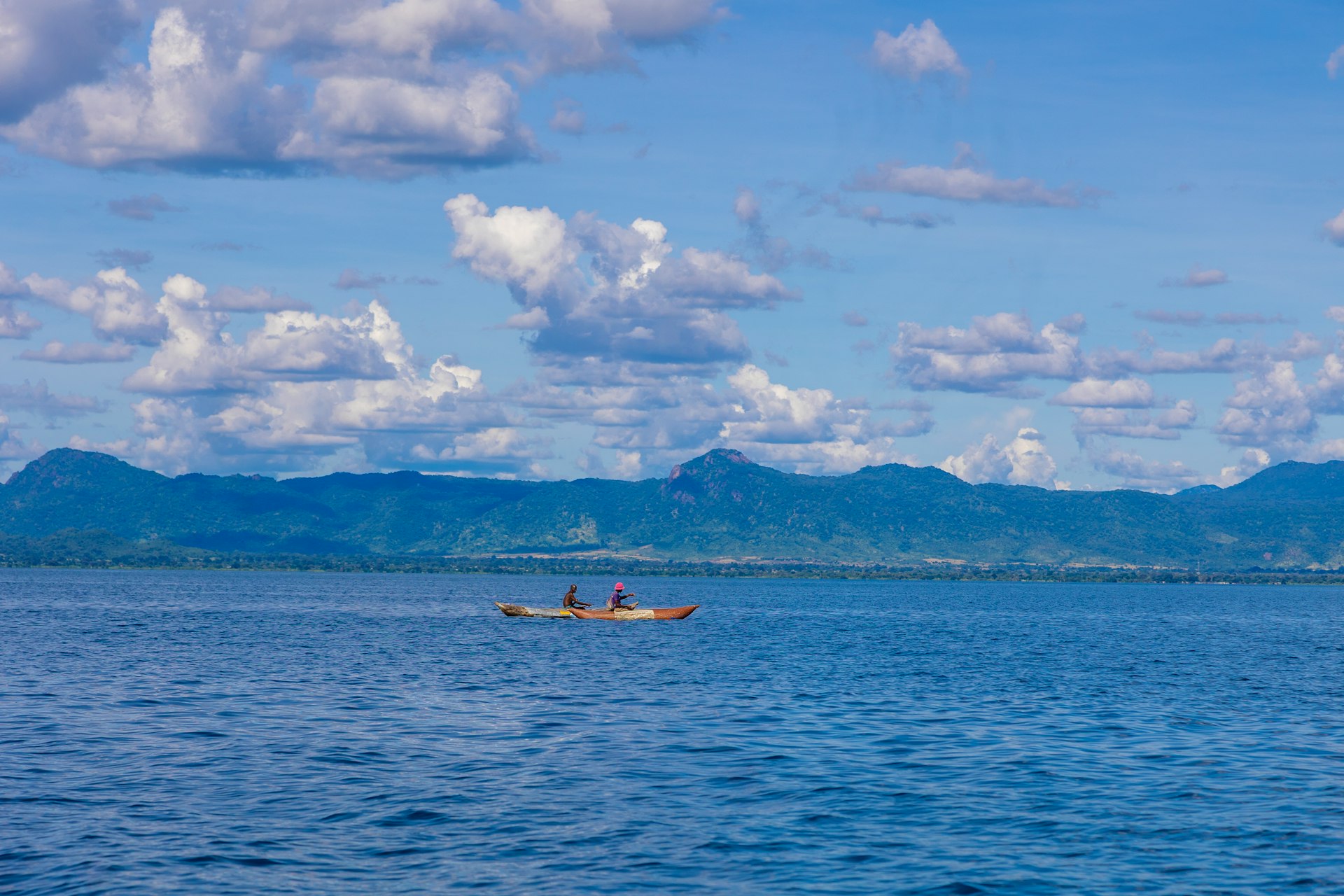
Lake Malawi
A 580-kilometre UNESCO-inscribed rift lake holding more fish species than any other lake on earth. Snorkelling and diving on Cape Maclear's clear water, off-grid island lodges, and a backpacker scene on the southern shore.
Africa's Inland Sea and Cichlid Capital
Photo by Omar Hakeem on Unsplash
About Lake Malawi
Lake Malawi is not merely a lake. It is a geological ancient, formed by the African Rift Valley some five to twenty million years ago, and in those millennia of isolation it has become one of the most biologically significant bodies of freshwater on the planet. The lake holds more fish species than any other lake on earth: over 1,000 species of cichlid, the vast majority found nowhere else, displaying a range of colour, form, and behaviour that has made it one of the most studied systems in evolutionary biology. The comparison to the Galápagos is not casual. Charles Darwin's finches evolved in geographic isolation to fill different ecological niches; Lake Malawi's cichlids have done the same in an aquatic environment, speciated into hundreds of forms occupying every layer of the lake.
The southern sector, centred on the Cape Maclear peninsula and the UNESCO-inscribed Lake Malawi National Park, is the most developed for tourism and the most immediately rewarding for first-time visitors. Snorkelling in the rocky shallows is the single most accessible way to encounter this living laboratory directly: visibility regularly exceeds 20 metres, the water is warm and tideless year-round, and the cichlid populations are dense and impossibly colourful. Mbuna, the rock-dwelling cichlids, display electric blue, vivid yellow, zebra-striped black-and-white in the intense territorial behaviour of small fish defending patch-sized kingdoms among the boulders. Every rocky outcrop in the national park's core area holds a distinct community.
The islands within the national park, particularly Mumbo and Domwe, extend the experience into a more remote register. Mumbo Island Camp is one of Malawi's most exclusive properties: raised tree platforms and open-sided chalets perched above the water, completely off-grid, with snorkelling directly from the rocky shoreline. The mainland village of Cape Maclear is a working fishing community whose life is organised around the lake, wooden dhows on the beach, nets drying in the sun, the morning catch on wooden racks, and whose human dimension is part of the destination as much as the cichlids are. Three to five nights covers the lake properly, longer for serious diving or island stays.
Things to Do in Lake Malawi
Snorkel the cichlid shallows
The most immediately accessible Lake Malawi experience. Rocky outcrops within swimming distance of most Cape Maclear lodges hold dense cichlid populations in shallow, clear water, no specialist equipment or experience required. Most lodges provide basic mask and fins; bringing your own makes the encounter more comfortable. Guided snorkelling trips covering multiple sites take 2–3 hours and are worth booking through your lodge.
Scuba dive the rocky structures
Lake Malawi is a freshwater diving destination of genuine quality. The absence of currents, the warm water (24–28°C year-round), and the extraordinary fish diversity create conditions well suited to learner and experienced divers alike. PADI instruction and certification courses are available at several Cape Maclear operators. Advanced divers reach deeper rocky structures where species communities differ significantly from the shallows.
Stay on Mumbo Island
A deserted island within the national park, accessible by kayak or motorboat from Cape Maclear. Mumbo Island Camp operates an off-grid eco-lodge of extraordinary character, raised tree platforms and open-sided chalets perched above the water, snorkelling directly from the shoreline, no roads or vehicles. Reaching Mumbo removes you from the mainland completely. Domwe Island next door offers more accessible adventure camping by the same operator.
Kayak between the rocky headlands
The lake's calm, tideless surface makes kayaking one of the most pleasurable ways to explore the national park's coastline. Half-day and full-day kayak hire is available at Cape Maclear lodges. The paddle from Cape Maclear to Mumbo Island takes 4–6 hours depending on wind and is an exceptional full-day adventure combining exercise, scenery, and wildlife encounter.
Sail a dhow at sunset
The lake's open water and consistent afternoon breezes support a small but active sailing community centred on Cape Maclear and Senga Bay. Sailing dhows and small keelboats are available for charter, sunset cruises across golden water with the Nankumba Hills behind the cape are among the simpler pleasures available in Malawi.
Walk Cape Maclear village
The mainland fishing community is a working village, not a backdrop. Walking the village paths with a local guide, visiting the fish market, buying chambo directly from the fishermen, watching nets dry in the sun, provides the human dimension that purely activity-focused programmes miss. The village also has a legitimate backpacker scene: bars, beach restaurants, and guesthouses with a low-key social atmosphere.
When to Visit Lake Malawi
Peak Season
May, October
The dry season delivers optimal lake conditions: clear water, calm surfaces, maximum underwater visibility, and reliable weather for all outdoor activities. July and August are particularly pleasant, warm enough for comfortable swimming (24–26°C water temperature) without the intense heat of September and October. The Senga Bay Sailing Regatta runs in September and the Lake of Stars Festival at Nkhotakota in October.
Green Season
November, April
The rains bring occasional rough water and temporarily reduced visibility in the southern shallows. The lake's deeper sites and offshore waters remain diveable throughout. Birdwatching around the lakeshore is exceptional in this period as migratory species arrive from November. Significantly lower rates and far fewer visitors.
Getting to Lake Malawi
From Blantyre to Cape Maclear is approximately 3 hours by road, north through Zomba and Mangochi on a well-maintained tarred road, with a 20km section to Cape Maclear after the Mangochi turn-off. From Lilongwe expect 4 hours via the M1 to Balaka, then east via Mangochi. Standard vehicles handle the Cape Maclear road in dry season; the final section becomes rutted after sustained rain and 4WD is advisable in wet conditions. The MV Ilala ferry stops at Monkey Bay (20km from Cape Maclear) on its weekly circuit, an atmospheric alternative for travellers with time.
Where to Stay
Lake Malawi's accommodation splits across three tiers. At the top, Mumbo Island Camp is the most exclusive property in the national park, off-grid, very limited capacity, books far in advance. Pumulani Lodge offers hillside villas above the lake at Cape Maclear with pool, spa, and kayaks included. In the mid-range, Chembe Eagles Nest is a well-regarded lakeshore lodge popular with self-drive visitors; Danforth Lodge is reliably good with friendly management. Multiple backpacker lodges along the Cape Maclear beachfront cover the budget tier, basic dorms to simple en-suites in a vibrant social atmosphere.
Travel Tips for Lake Malawi
Frequently Asked Questions
- Is Lake Malawi swimming actually safe with bilharzia?
- With informed precautions, yes. The risk concentrates in shallow, reedy, slow-moving water near the shoreline. Deep-water snorkelling, offshore diving, and the open-water island shorelines carry significantly lower risk. Most travellers swim and snorkel at Cape Maclear and Mumbo without incident. Post-travel screening is sensible regardless, bilharzia is fully treatable if caught early.
- How does Lake Malawi snorkelling compare to ocean snorkelling?
- Different rather than worse. The species are freshwater cichlids, colourful, behaviourally complex, and concentrated in rocky-habitat communities. There is no coral and no large pelagic life, but the visibility, clarity, and species diversity are immediately rewarding for snorkellers experienced in coral reefs. For those who have not seen freshwater cichlids before, it is genuinely surprising.
- Cape Maclear or Likoma Island?
- Different experiences. Cape Maclear is more accessible, more developed, and the easier introduction to the lake, particularly for first-time Malawi visitors with limited time. Likoma is more remote, more exclusive (Kaya Mawa), and has the world-class accident of St Peter's Cathedral. Many travellers do both: 3 nights at Cape Maclear plus 3 nights at Likoma is a full lake itinerary.
- How long should I spend at the lake?
- Three to five nights at minimum. Less than three feels rushed, the lake's pace takes a day to adjust to. Five nights covers Cape Maclear thoroughly with at least one night on Mumbo. Serious divers or island-hoppers can comfortably spend 7–10 nights on the lake without exhausting the offering.
Explore More, Lake Malawi
Things To Do
Plan Your Trip
More in Malawi
Liwonde National Park
Malawi's premier Big Five safari, transformed by African Parks from a depleted reserve into a functioning ecosystem with rhino tracking, boa…
Majete Wildlife Reserve
Malawi's first Big Five reserve, rebuilt from complete depletion by African Parks since 2003. Lions, black rhinos, elephants, leopards, buff…
Nyika National Park
Malawi's largest park, 3,134 square kilometres of high-altitude montane grassland averaging 2,000 metres. Roan antelope, leopards, 213 orchi…
Mount Mulanje
A 3,002-metre granite massif rising abruptly from the tea estates of southern Malawi. Twenty distinct peaks, the critically endangered Mulan…
Lilongwe
Malawi's primary international entry point and a sprawling, low-rise capital with a wildlife sanctuary in its centre, an Old Town market tha…
Nkhotakota Wildlife Reserve
Malawi's largest reserve and the recipient of the largest wildlife translocation in African history, 500 elephants and 2,000 other animals m…
Likoma Island
A 17-square-kilometre Malawian sovereign island in the middle of Mozambican lake waters. St Peter's Cathedral, completed 1905, larger in foo…
Zomba Plateau
An 1,800-metre forested plateau above Malawi's former colonial capital. Hiking and mountain biking on the forestry trail network, escarpment…
Livingstonia & Chongoni
Two cultural anchors at opposite ends of the Malawian timeline. Livingstonia, a 19th-century Scottish missionary town perched 700 metres abo…